
Philadelphia County Property Tax Records: OPA, Assessments, and the City-County System
Philadelphia County property tax records are unlike any other set of records in Pennsylvania. Philadelphia is the only consolidated city-county in the Commonwealth, meaning the city and county share a single government and a single property assessment system covering all parcels within the city limits. With over 1.6 million residents and hundreds of thousands of taxable parcels ranging from rowhouses in Fishtown to commercial towers along Market Street, Philadelphia's property tax system is the largest and most complex in the state. Rather than a traditional county assessment office, Philadelphia uses the Office of Property Assessment -- the OPA -- to determine the value of all real property for taxation purposes.
Philadelphia County Quick Facts
Office of Property Assessment: Philadelphia's Assessment Authority
The Office of Property Assessment is the city agency responsible for determining the assessed value of every parcel in Philadelphia for real estate tax purposes. The OPA operates under the authority of the Philadelphia Home Rule Charter and city ordinance. It is the functional equivalent of a county assessment office, but its structure, scale, and methodology are tailored to one of the most densely built urban environments in the United States. The OPA's primary phone line is (215) 686-9200, and its official information page is at phila.gov/departments/office-of-property-assessment.
The OPA determines property values using a Computer Assisted Mass Appraisal system, commonly referred to as CAMA. Mass appraisal is a systematic approach to valuing large numbers of properties as of a given date using standardized methods, statistical testing, and common data. The CAMA system applies market data, cost schedules, and income approaches to different property types across the city. Residential properties are typically valued using sales comparison analysis within comparable market segments, while income-producing properties such as apartment buildings and commercial real estate often incorporate income capitalization methodology. New construction and renovations trigger reassessment based on building permit data.
| Office | Office of Property Assessment (OPA) |
|---|---|
| Phone | (215) 686-9200 |
| Website | phila.gov/departments/office-of-property-assessment |
| Valuation Method | Computer Assisted Mass Appraisal (CAMA) |
| City Website | phila.gov |
| Tax Balance Lookup | phila.gov tax balance lookup |
The OPA assigns every parcel in Philadelphia a unique OPA account number, sometimes called the account number or map number. This identifier is used across city systems and is the primary key for looking up property records in the city's online databases. Knowing your OPA account number significantly streamlines searches for tax bills, assessment data, and appeals history.
Note: Philadelphia's property tax system is governed by city ordinance and the Philadelphia Home Rule Charter, not by the standard PA county assessment statutes that apply to the other 66 Pennsylvania counties.
Searching Philadelphia Property Tax Records Online
Philadelphia's property search portal is available at property.phila.gov. The portal allows searches by street address, OPA account number, or map number. It provides assessed value, tax balance information, zoning classification, sales history, and other parcel-level data. The interface is public and does not require registration or login to access basic property information.
The portal includes several specialized search features worth knowing. A 250-foot radius search lets you pull up all parcels within a quarter-block of a given address, which is useful for neighborhood research, due diligence, or identifying adjacent properties. A block-level search is available using the "block:" prefix before a street name -- for example, entering "block: 1500 market" returns all properties on that block of Market Street. These tools make the Philadelphia system especially useful for real estate professionals, researchers, and community members conducting area-wide property studies. The city discontinued the Search By Owner feature to protect resident privacy, so name-based lookups are no longer available through the public portal.
Tax balance information -- including current charges, prior year amounts, and payment history -- is accessible at the city's tax balance lookup page. Property owners can verify whether taxes are current before a sale, refinancing, or after making a payment. This tool is maintained by the Philadelphia Department of Revenue and pulls live data from the city's billing system.
Pennsylvania's Right-to-Know Law establishes a statewide presumption that public records are accessible upon request. Although Philadelphia's OPA data is largely available through the online portal, formal Right-to-Know requests remain an option for data sets or records not surfaced through the standard search interface. The PA Consolidated Statutes provide the broader legal framework within which Philadelphia's local ordinances operate.
Philadelphia Property Tax Records: What They Document
Each OPA record for a Philadelphia property contains a substantial amount of information about the parcel. The record includes the OPA account number, the property address, the owner's name and mailing address, the property classification (residential, commercial, industrial, vacant land, etc.), the land area in square feet, the building description including construction type and year built, and the assessed value broken into land and improvement components. The assessed value is the figure used by the city to calculate the real estate tax bill.
Philadelphia imposes a real estate tax based on the assessed value of each parcel multiplied by the applicable millage rate set annually by City Council and the School District of Philadelphia. Philadelphia is an independent school district, meaning the school district tax is set and administered separately from the city's general tax, though both appear on the same annual tax bill. The Department of Revenue handles billing and collection of both levies.
The property portal also displays recorded sales history for each parcel, drawn from recorded deed transfers. Sales data includes sale date, sale price, and buyer information as reported at the time of recording. This history is useful for understanding market value trends and for property owners preparing for an appeal.
Philadelphia's property mix is among the most varied in Pennsylvania. The city contains tens of thousands of rowhouses that define many of its historic neighborhoods, along with multi-family rental buildings, industrial and warehouse properties, large commercial and office towers, hospitality properties, and significant institutional parcels held by universities, hospitals, and non-profit organizations. Exempt properties, including those owned by the city, the school district, religious institutions, and non-profits, are recorded by the OPA but are not subject to real estate tax unless they have taxable portions.
Philadelphia Property Tax Services
The City of Philadelphia provides multiple property tax services through its integrated online platforms. Owners can look up assessed values, review tax bills, set up payment agreements, and apply for relief programs all through the city's official web presence. The main landing page for property tax services is at phila.gov/services/property-lots-housing/property-taxes.
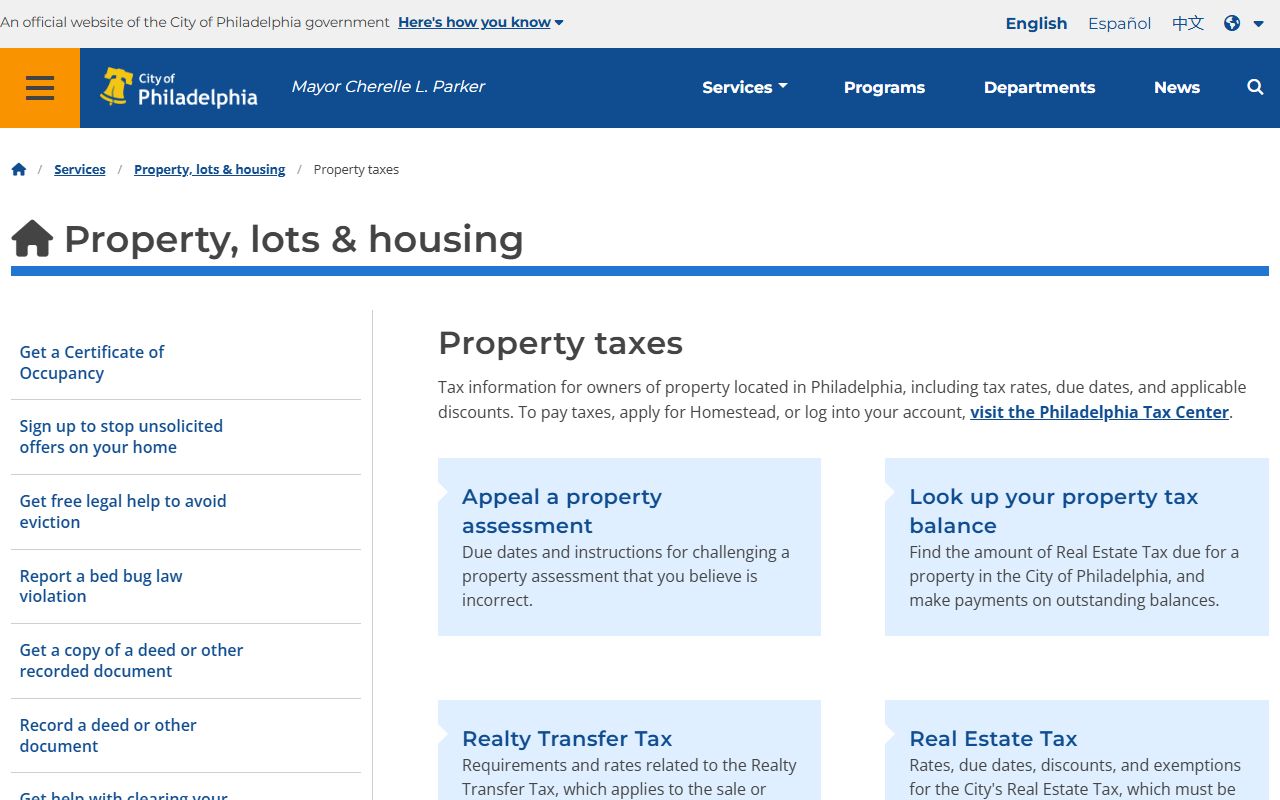
This services hub connects property owners to the full range of city tax functions -- from looking up a current balance to applying for an installment payment plan or filing for exemption. The Department of Revenue also handles delinquent real estate tax collections and can arrange payment agreements for owners who have fallen behind. Active payment plans may prevent enforcement actions such as tax liens or Sheriff's Sale proceedings.
Note: The Pennsylvania Department of Revenue administers state-level tax relief programs like the Property Tax/Rent Rebate that supplement Philadelphia's own local relief offerings -- both state and city programs can apply to eligible Philadelphia property owners.
Assessment Appeals: Board of Revision of Taxes
Property owners in Philadelphia who disagree with their assessed value have the right to appeal to the Board of Revision of Taxes. The BRT is an independent quasi-judicial board that hears assessment challenges from both property owners and taxing authorities. It is separate from the OPA and provides an impartial forum for reviewing OPA determinations. Information about the BRT and its appeal procedures is at phila.gov/departments/board-of-revision-of-taxes.
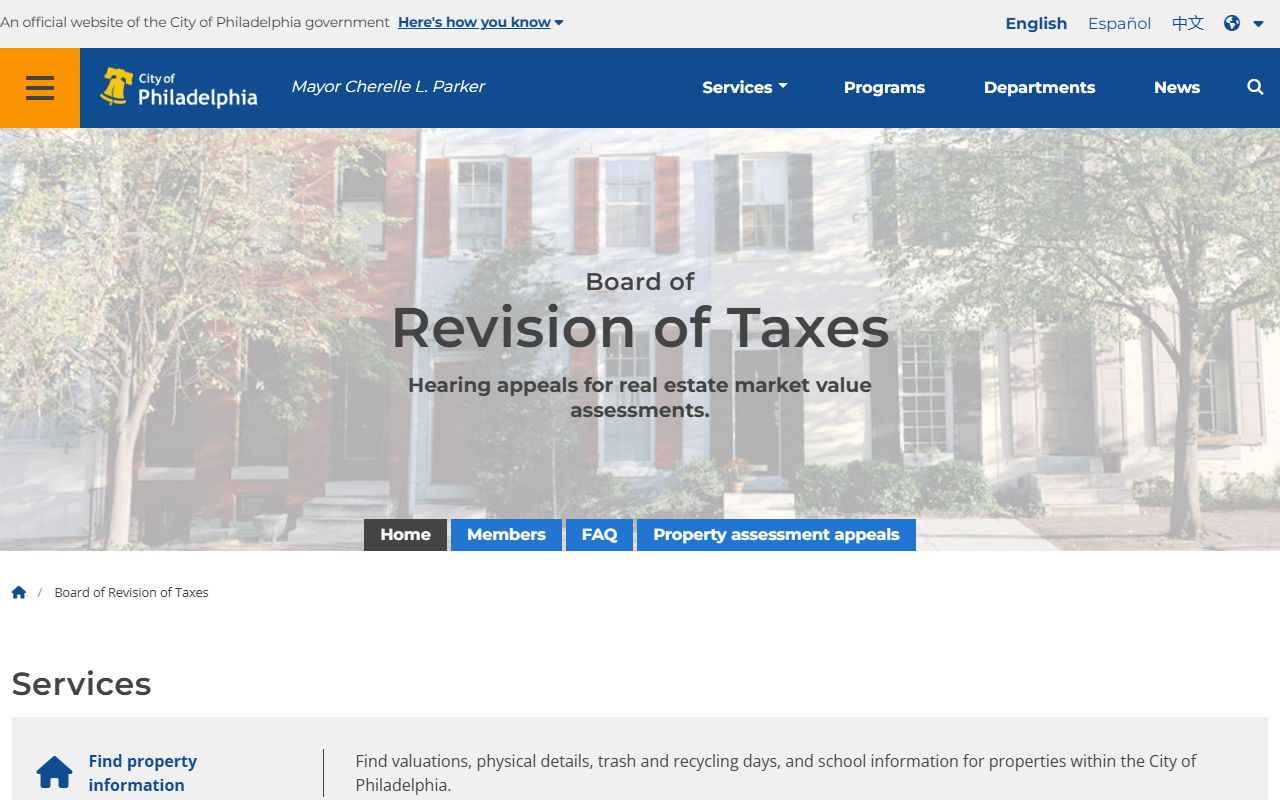
The annual deadline to file a real estate assessment appeal with the BRT is the first Monday in October. This deadline applies to appeals contesting the assessed value for the following tax year. Appeals filed after the deadline are generally not accepted for that cycle, making timely filing essential. The BRT conducts hearings during which property owners may present evidence including comparable sales, independent appraisals, photographs documenting property conditions, and income and expense data for income-producing properties. The BRT issues written decisions and may affirm, increase, or reduce the assessed value.
The BRT offers virtual hearings conducted via Zoom, making it more accessible for property owners who are unable to appear in person at City Hall. Instructions for Zoom hearings are provided after a hearing date is scheduled. Property owners choosing virtual hearings should have their evidence prepared as digital exhibits that can be shared during the session. Decisions can be further appealed to the Philadelphia Court of Common Pleas if a party disagrees with the BRT's outcome.
Note: Taxing bodies including the School District of Philadelphia also have standing to appeal assessed values they consider too low, so property owners should be aware that appeals can flow in both directions.
Property Tax Relief Programs in Philadelphia
Philadelphia offers several property tax relief programs designed to assist homeowners, seniors, and lower-income residents. Understanding the available programs -- and the distinctions between them -- is important for property owners seeking to reduce their tax burden. The city's consolidated tax relief information is maintained at phila.gov/services/property-lots-housing/property-taxes.
The Homestead Exemption is the most broadly available Philadelphia relief program. Owner-occupied residential properties that qualify as the owner's primary residence are eligible for a reduction in taxable assessed value of $100,000. At the city's current tax rate, this exemption produces meaningful annual savings for the typical Philadelphia homeowner. The exemption must be applied for through the OPA and, once approved, renews automatically as long as the property remains the owner's primary residence. First-time applicants and recent purchasers should apply promptly after taking ownership of their home.
The Low-Income Property Tax Freeze program freezes real estate tax bills at their 2024 amounts for qualifying low-income homeowners. Once enrolled, the owner's tax bill does not increase in future years even if the assessed value or tax rate rises. A Senior Citizen Tax Freeze is similarly available for qualifying older Philadelphians. Both freeze programs require income documentation and periodic recertification. Philadelphia also offers Tax Abatement programs for new construction and qualifying improvements to existing buildings. These abatements can significantly reduce tax obligations for developers and homeowners undertaking renovations, though the scope and duration of available abatements have been subject to City Council revisions over recent years.
The Pennsylvania Property Tax/Rent Rebate program, administered by the PA Department of Revenue, provides annual rebates to eligible seniors aged 65 and older, widows and widowers aged 50 and older, and disabled individuals aged 18 and older based on income thresholds. Philadelphia residents who qualify can stack state rebates with city relief programs in some circumstances, reducing their overall property tax exposure. Philadelphia's Department of Revenue and local community organizations often provide application assistance for residents navigating multiple programs simultaneously.
Philadelphia Department of Revenue and Tax Collection
The Philadelphia Department of Revenue is responsible for billing, collecting, and enforcing real estate tax obligations in the city. While the OPA determines assessed values and the BRT hears appeals, the Department of Revenue issues annual tax bills and manages the payment process. Its official page is at phila.gov/departments/department-of-revenue.
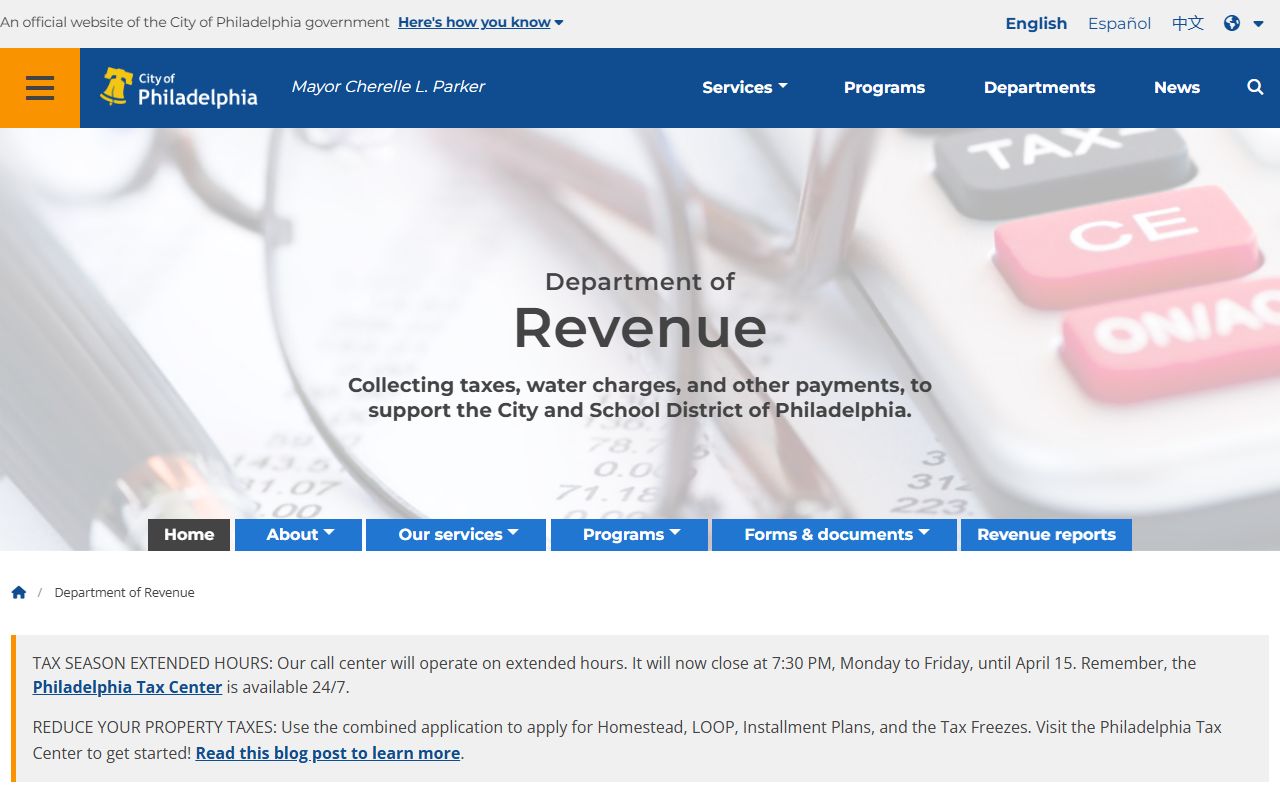
Real estate tax bills in Philadelphia are mailed annually. Property owners who have not received a bill should verify their mailing address with the Department of Revenue and confirm the OPA account number on file for their property. Escrow accounts managed by mortgage servicers generally receive bills automatically, but owners with a change in servicer or who have paid off their mortgage should confirm that billing is reaching the correct address. Delinquent real estate taxes accrue interest and penalties and can ultimately result in a lien placed against the property. Philadelphia uses a tax sale process administered through the Sheriff's Office for properties with significant delinquencies.
Installment payment agreements are available for property owners who are unable to pay a balance in full. The Department of Revenue administers these agreements and can establish a structured repayment schedule that prevents enforcement action while the owner is in compliance with the plan. Property owners facing financial hardship should contact the Department of Revenue promptly rather than allowing delinquency to escalate.
Cities in Philadelphia County
Philadelphia County is a consolidated city-county. The city of Philadelphia is the only municipality within the county, and all property assessment, tax billing, and appeals functions are conducted through city agencies that serve the entire county.
Nearby Counties
Philadelphia County borders four Pennsylvania counties, each with its own independent assessment office and property tax system. Buyers and investors working across county lines should verify the applicable assessment practices and tax rates in each jurisdiction.