
Philadelphia Property Tax Records and Assessment Data
Philadelphia is Pennsylvania's largest city and home to one of the most detailed property records systems in the state. The Office of Property Assessment manages valuations for every parcel in the city, and residents can access ownership details, assessed values, sales history, and tax balances through several online portals. Whether you are researching a specific address or exploring neighborhood trends, Philadelphia property tax records provide a clear window into how real estate is valued and taxed across this historic city's many diverse neighborhoods.
Philadelphia Quick Facts
Philadelphia Property Tax Assessment: The Office of Property Assessment
The Office of Property Assessment (OPA) is the agency responsible for determining the value of every piece of property in Philadelphia. Located at 601 Walnut Street, Suite 300 West, the OPA can be reached by phone at (215) 686-4334 or through the OPA Hotline at (215) 686-9200. Office hours run Monday through Friday, 8:00 AM to 3:30 PM.
The OPA uses a CAMA (Computer Assisted Mass Appraisal) system to assess properties across the city. This technology-driven approach allows assessors to analyze large volumes of property data consistently and apply valuation models across similar property types. The CAMA system considers factors such as location, building size, condition, and recent comparable sales when generating assessed values for individual parcels. Because Philadelphia contains hundreds of thousands of properties spanning a wide range of types and neighborhoods, the CAMA system is essential to maintaining consistency across this enormous portfolio.
Real estate tax revenue provides a significant portion of funding for Philadelphia's public schools. This makes the accuracy of OPA assessments particularly important not just for individual property owners but for the city's entire educational infrastructure. Property owners who believe their assessment is inaccurate have formal avenues to challenge it through the Board of Revision of Taxes.
The Pennsylvania Consolidated Statutes, Title 72, governs property taxation statewide and provides the legal framework under which the OPA operates. Philadelphia's assessment practices must conform to these state standards while also reflecting the city's unique real estate market dynamics.
Note: Philadelphia is unique among Pennsylvania municipalities in that the city and county are coterminous, meaning Philadelphia County and the City of Philadelphia are governed as a single unified entity with shared boundaries.
How to Search Philadelphia Property Tax Records Online
The Philadelphia Property Search portal is the primary tool for looking up property information in the city. Available at property.phila.gov, the portal allows users to search by street address, OPA account number, or map number. It provides comprehensive data including ownership details, sales history, assessed values, and physical property characteristics all in one place.
The portal offers several powerful search methods. Users can conduct map-based selection by clicking directly on a property within an interactive map interface. The 250-foot radius search feature returns all properties within a defined distance of a specific address, which is useful for comparative research or neighborhood analysis. Users can also draw custom boundaries to search for all properties within a geographic area, or use a block search by typing "block:" before an address to retrieve all properties on that particular block.
The Philadelphia Office of Property Assessment manages valuations citywide using its CAMA system.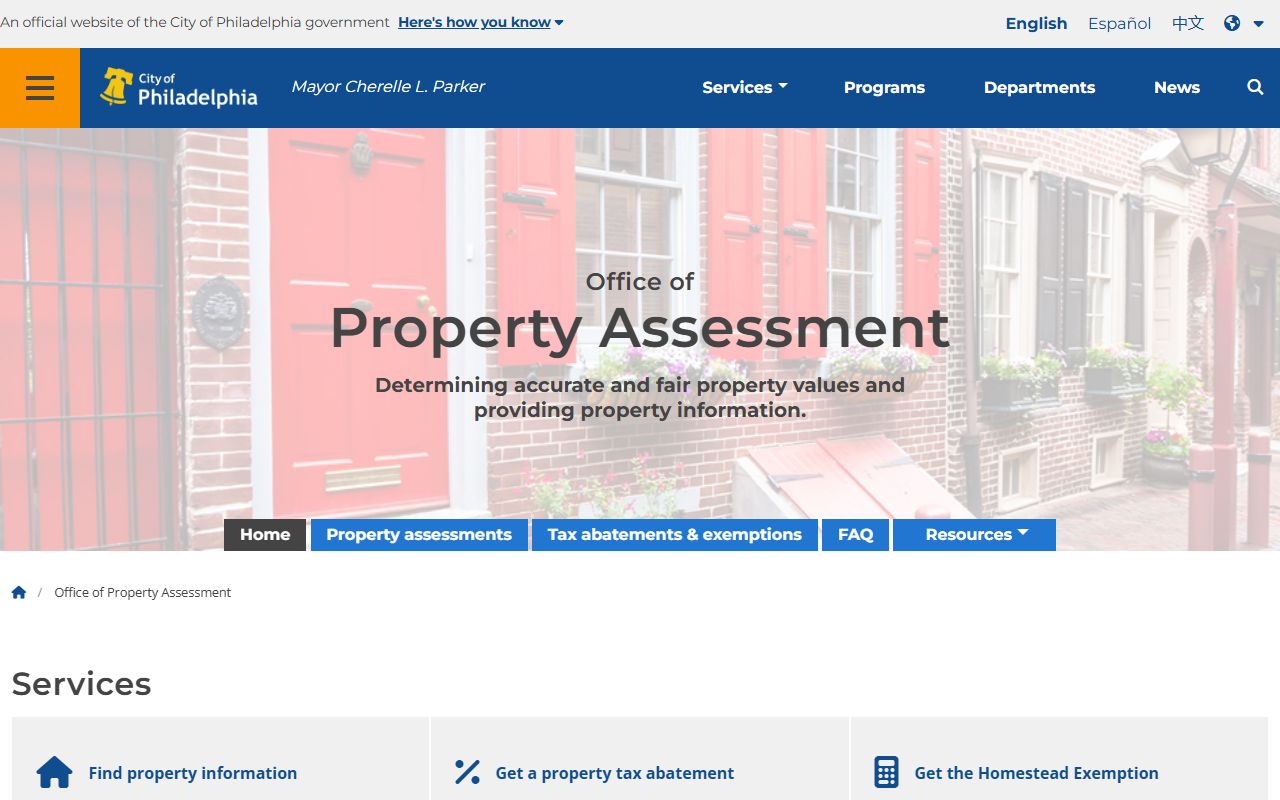
The OPA coordinates all assessment data feeding into the Philadelphia Property Search portal, keeping records current across more than half a million parcels.
For tax balance information, the city maintains a dedicated lookup tool at the Tax Balance Lookup page. Enter either a street address or a nine-digit OPA account number to retrieve current tax balances and payment status. Online payment is available directly through this portal, making it convenient for property owners to resolve outstanding amounts without visiting a city office in person.
Philadelphia's property search portal provides ownership, value, and sales data for every parcel in the city.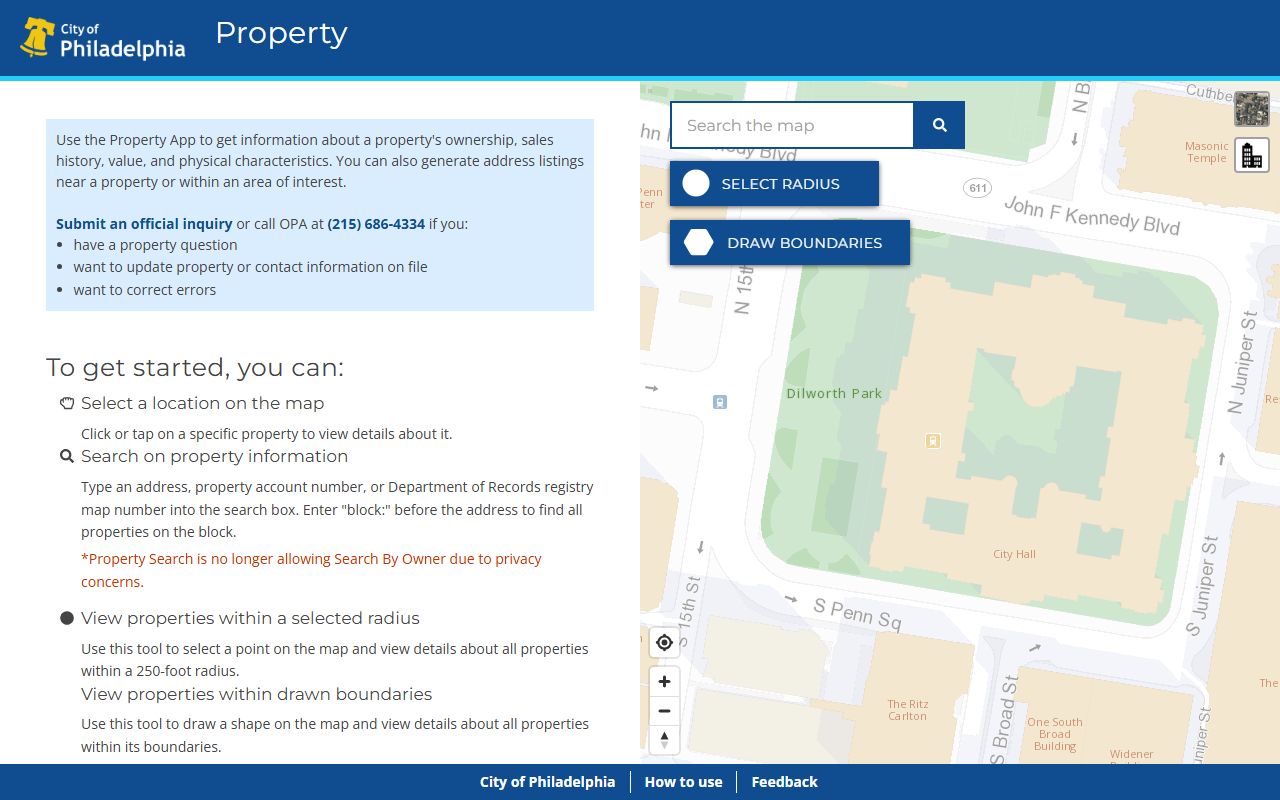
The portal is updated regularly and serves homeowners, real estate professionals, and researchers looking for detailed records on any Philadelphia address.
It is worth noting that the Search By Owner function was discontinued due to privacy considerations. Researchers who need to locate properties by owner name may need to contact the OPA directly or use third-party property record services. The Pennsylvania Right-to-Know Law provides a formal mechanism for requesting records that are not available through public-facing portals, and all property records are presumed public under this law.
Note: The Philadelphia Tax Center allows property owners to make online payments, apply for relief programs, and manage their account information through a single unified interface.
Philadelphia Property Tax Records: What the Data Reveals
Philadelphia property tax records contain a rich set of data points for each parcel in the city. The property search portal displays current ownership information, mailing addresses, and deed reference numbers that connect to recorded documents maintained by the Department of Records. Sales history shows prior transaction dates and prices, allowing users to track how a property's market value has changed over multiple transactions and years.
Physical characteristics recorded in the OPA database include lot dimensions, building square footage, number of stories, construction type, and the property's current condition grade. These attributes directly influence the assessed value assigned by the CAMA system. For residential properties, the portal often includes building sketches and in some cases property photographs, which help users verify that recorded characteristics match the actual physical condition of a home.
The Tax Balance Lookup tool lets Philadelphia property owners check outstanding taxes by address or OPA number.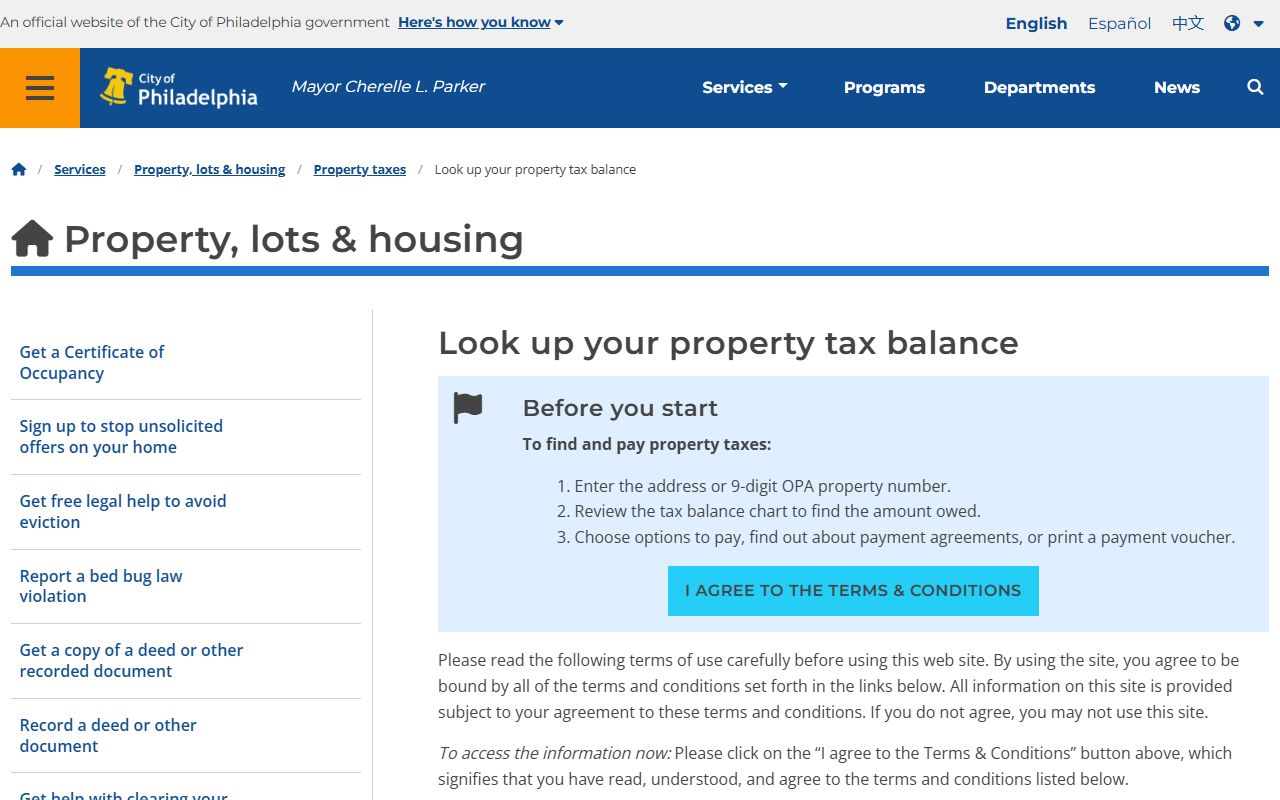
Online payment options are integrated directly into the balance lookup, making it straightforward for owners to resolve outstanding tax amounts without leaving the portal.
The assessed value shown in records reflects the OPA's estimate of a property's market value. Philadelphia conducts reassessments on an ongoing basis rather than on a fixed periodic cycle, which means values can change from year to year. Property owners receive written notice of any changes to their assessment and have the right to contest valuations they believe are inaccurate through the formal BRT process.
According to statewide data, the median property tax in Pennsylvania is approximately $2,223 on a median home value of $164,700. Philadelphia's dense urban market produces a wide range of assessed values depending on neighborhood, property type, and recent sales activity in each area.
Property Assessment Appeals in Philadelphia: The Board of Revision of Taxes
Property owners who disagree with their OPA assessment can file a formal appeal with the Board of Revision of Taxes (BRT). The BRT hears formal appeals on assessed values and related matters, operating independently from the OPA to provide an objective review process for Philadelphia property tax records disputes.
The appeal deadline in Philadelphia differs from most Pennsylvania counties. Rather than the statewide common deadline of August 1, Philadelphia's BRT deadline falls on the first Monday in October each year. This extended window gives property owners additional time to gather evidence and prepare their case before presenting it to the board. The BRT office is open Monday through Friday, 8:30 AM to 4:30 PM.
Hearings may be conducted virtually via Zoom using Meeting ID 939 0531 5043 and Passcode 276218, making the process more accessible for property owners who cannot appear in person. Grounds for appeal include assessments that appear too high or too low, values that do not match comparable nearby properties, and errors in recorded facts such as square footage or property condition. The BRT also hears appeals related to denied tax abatements, denied nonprofit exemptions, and Homestead exemption decisions.
The Pennsylvania Courts system provides a further avenue for appeal if a property owner disagrees with the BRT's final decision. Cases may be elevated to the Court of Common Pleas of Philadelphia County for additional review.
Note: Filing an appeal does not delay or suspend the obligation to pay property taxes while the case is pending; owners should continue making payments to avoid penalties and interest charges during the appeal process.
Property Tax Relief Programs for Philadelphia Residents
Philadelphia offers several programs designed to reduce the property tax burden on eligible residents. The Homestead Exemption reduces the taxable assessed value of an owner-occupied home by $100,000. This is one of the most generous homestead exclusions in Pennsylvania and can result in substantial annual savings for qualifying homeowners. Applications are handled through the Philadelphia Department of Revenue, located at 1401 John F. Kennedy Blvd, Philadelphia, PA 19102, reachable at (215) 686-9200.
The Longtime Owner Occupants Program, known as LOOP, provides relief to long-term homeowners whose property assessments have increased significantly. This program is particularly valuable in neighborhoods that have experienced rapid appreciation, where long-term residents might otherwise face substantial tax increases on homes they have owned for many years. The Low-Income Property Tax Freeze locks property tax bills at 2024 amounts for qualifying low-income residents, preventing increases even if assessments rise in subsequent years.
Philadelphia also administers Tax Abatement programs for new construction and major renovation projects. These abatements can eliminate or reduce property taxes for a defined number of years, which has been a significant incentive for development across many neighborhoods. A combined application process allows property owners to apply for the Homestead Exemption, LOOP, Installment Plans, and Tax Freezes through a single submission, simplifying access to multiple programs at once.
At the state level, the Pennsylvania Department of Revenue administers the Property Tax/Rent Rebate program, which provides rebates to seniors aged 65 and older, widows and widowers aged 50 and older, and people with disabilities aged 18 and older who meet income requirements. The Working PA Tax Credit offers an additional $805 benefit for qualifying households, providing further support to lower-income Philadelphians.
Philadelphia County Property Records and Related Resources
Because Philadelphia is a consolidated city-county, many functions that are handled separately in other parts of Pennsylvania are unified here. The Philadelphia Department of Records serves as the equivalent of a Recorder of Deeds, maintaining all property transfer records, mortgages, and liens filed within the city. These records are searchable online and provide the official chain of title for every parcel in Philadelphia.
The Pennsylvania Department of Community and Economic Development (DCED) provides support to local governments including Philadelphia, particularly around housing programs and community development initiatives that affect property values and the local tax base. DCED resources can be helpful for understanding how state-level housing policy intersects with local assessment practices.
Property owners and researchers can also consult the Pennsylvania State Data Center for demographic and economic data that contextualizes Philadelphia's real estate market. Population trends, income levels, and housing stock characteristics are all available and help explain patterns in assessed values across different parts of the city.
The Pennsylvania county property records directory provides an overview of how Philadelphia's records system fits within the broader statewide framework for property tax administration. The Tax Foundation also publishes comparative data on Pennsylvania's overall property tax burden relative to other states.
Note: Philadelphia's Department of Records maintains historical deed records dating back to the city's earliest years and is one of the most extensive urban property record archives in the northeastern United States.
Philadelphia County Connection
Philadelphia is a consolidated city-county, meaning the city and Philadelphia County share the same boundaries and government structure. The Office of Property Assessment and all related property tax functions operate under this unified city-county arrangement.
Nearby Cities
Explore property tax records for other cities near Philadelphia.