
Northampton County Property Tax Records
Northampton County property tax records are maintained by the Assessment Division in Easton, serving the eastern end of the Lehigh Valley metropolitan area along the Delaware River. The county conducts biennial reassessments, updating property values every two years to keep assessed values aligned with current market conditions. Online access to Northampton County property tax records is available through the ncpub.org portal, which provides read-only search access to county tax data. This guide covers how to find property tax records, how the biennial reassessment process works, how to appeal an assessment, and what relief programs are available to Northampton County property owners.
Northampton County Quick Facts
Northampton County Assessment Office and Contact Details
The Northampton County Assessment Division is located at the Northampton County Government Center, Room 305, 669 Washington Street, Easton, PA 18042. The main county phone number is (610) 559-3141, and the Assessment Division direct line is (610) 829-6155. General county information and department resources are available at northamptoncounty.org. The Assessment Division is responsible for the development and certification of tax rolls for county, municipal, and school district real property throughout the county. Pennsylvania law requires each county to maintain a uniform system of property valuation, and Northampton County's biennial reassessment cycle is one mechanism through which it meets that requirement.
| Office | Northampton County Assessment Division |
|---|---|
| Address | Government Center, Room 305, 669 Washington St., Easton, PA 18042 |
| Main Phone | (610) 559-3141 |
| Assessment Division | (610) 829-6155 |
| Website | northamptoncounty.org |
| Online Records | ncpub.org |
| Reassessment Cycle | Biennial |
Pennsylvania also requires that county assessors complete a comprehensive training course in assessment theory and pass a certification examination within two years of beginning service. After certification, assessors must participate in continuing education to maintain their credentials. This requirement ensures that the professionals managing Northampton County property valuations are trained in current assessment methodology and remain current with evolving legal requirements.
The Assessment Division maintains a range of maps for public use. These include agricultural security areas maps, preserved farms maps, interactive tax maps, and council district maps. Planners, researchers, property owners, and government agencies use these resources for geographic information about land uses and administrative boundaries across the county.
Note: Pennsylvania's Uniformity Clause at Article VIII, Section 1 of the state constitution requires that all real property of the same class be assessed at the same percentage of value, making uniform and regular reassessments legally essential.
Accessing Northampton County Property Tax Records Online
Northampton County provides online access to property tax records through ncpub.org. This portal gives users read-only access to tax record information maintained by the county, allowing searches of property data and assessment information for parcels throughout the county. The site functions as a demonstration portal, and the county notes that the accuracy and currency of data are not guaranteed. Users should treat the online information as a starting point and verify critical details directly with the county offices when precision matters.
The image below comes from the Northampton County website, where the Assessment Division provides information on property tax records, valuation procedures, and county resources for property owners.
The Northampton County Government Center in Easton houses the Assessment Division and is the in-person destination for property owners needing direct assistance with assessment questions, appeals, or program enrollment.
The ncpub.org portal also supports online tax payment options, which is convenient for property owners who do not reside locally. The image below is sourced from the ncpub.org online tax records portal, showing the county's web-based interface for searching property tax data.
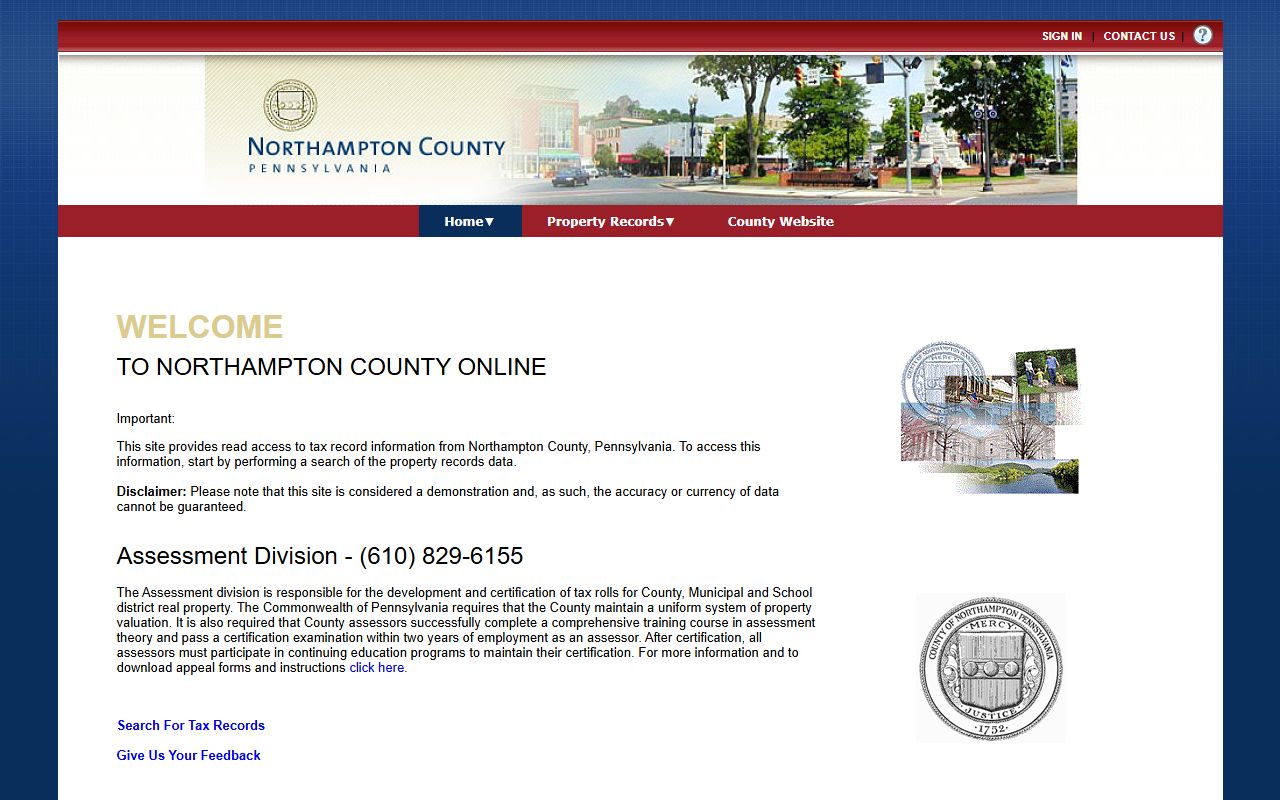
The ncpub.org portal provides a convenient read-only view of Northampton County property tax records, with payment functionality available for current and in some cases delinquent balances.
In-person access is available at the Government Center in Easton. Call the Assessment Division directly at (610) 829-6155 for questions about assessed values, property characteristics, or the reassessment process. Pennsylvania's Right-to-Know Law establishes that assessment records are presumed public. The Office of Open Records administers the formal request process statewide for cases where standard access does not produce the information needed.
Northampton County Biennial Reassessment Process
Northampton County is among a small number of Pennsylvania counties that conduct biennial reassessments, updating assessed values every two years rather than waiting many years between countywide reviews. Each reassessment involves a systematic review of recent sales data to calibrate the values assigned to all property types across the county. Property owners receive notification of their updated assessed values following each reassessment and have an opportunity to appeal values they believe are inaccurate.
The Commonwealth of Pennsylvania requires each county to maintain a uniform system of property valuation. Biennial reassessments in Northampton County help satisfy this requirement by regularly aligning assessed values with current market conditions. Properties that have appreciated in value see their assessments updated upward; those that have declined see reductions. This regular recalibration reduces the assessment inequities that accumulate in counties that go many years between full reassessments.
The PA Consolidated Statutes, Title 72 establish the legal framework for property assessment and taxation across all 67 Pennsylvania counties. Within that framework, Northampton County has adopted a biennial cycle to fulfill its obligation to assess property uniformly. The GIS-based tax maps maintained by the county integrate with assessment data to provide a comprehensive view of parcel characteristics and values, supporting both the reassessment process and public access to property information.
Property owners in Northampton County should be aware that following each biennial reassessment, their assessed value may change. Reviewing the updated value promptly and comparing it to recent sale prices of similar properties in the area is the best way to evaluate whether the new assessment is reasonable. If a discrepancy exists, the appeal process is available to seek a correction.
Northampton County Property Tax Assessment Appeals
Northampton County property owners who disagree with their assessed value may file a formal appeal with the Board of Assessment Appeals. The appeal process is open after each biennial reassessment, as well as during the standard annual appeal window. Because reassessments occur every two years, property owners have regular opportunities to review updated values and challenge any they believe are inaccurate or out of step with comparable properties.
The standard annual deadline for filing an appeal is August 1 of the applicable tax year. Property owners should confirm the specific deadline with the Assessment Division at (610) 829-6155, particularly during reassessment years when special procedures may apply. Appeals must be submitted in writing, identifying the parcel, the current assessed value, the owner's estimated value, and the factual basis for the challenge.
Strong appeals are built on solid evidence. Professional appraisals, comparable recent sales, photographs of property conditions, and documentation of physical defects or unusual circumstances all serve as useful supporting materials. The Board reviews evidence from both property owners and taxing authorities before issuing its decision. Board decisions may be appealed to the Court of Common Pleas, and further appeals proceed through the Pennsylvania Courts system under the framework established by Title 72 of the PA Consolidated Statutes.
Note: In Northampton County's biennial reassessment cycle, assessment notices are issued more frequently than in counties that reassess less often, so property owners should watch for reassessment notices and act promptly if an appeal is warranted.
Tax Relief Programs in Northampton County
Northampton County property owners have access to several programs that reduce annual property tax obligations. The Homestead Exclusion under Act 72 of 2004 reduces the assessed value of a qualifying owner-occupied primary residence before school property taxes are calculated. Homeowners apply through the Assessment Division; once approved, the exclusion is applied by all participating taxing bodies. The Farmstead Exclusion extends similar treatment to qualifying farm buildings on agricultural properties where the owner resides, benefiting farm families in the county's active agricultural townships.
Pennsylvania's Clean and Green program under Act 319 of 1974 is available to qualifying parcels of 10 or more contiguous acres. Enrolled properties are assessed at use value rather than market value, which can significantly reduce the tax burden on working farms and forest reserve land. Northampton County maintains agricultural security area maps and preserved farms maps through its GIS system, reflecting the importance of farmland preservation in the county's planning framework. Landowners interested in Clean and Green enrollment should contact the Assessment Division for eligibility and application details. More than 9.3 million acres are enrolled statewide, and rollback taxes apply when enrolled land is converted to non-qualifying uses.
The Pennsylvania Department of Revenue administers the Property Tax and Rent Rebate Program for qualifying seniors aged 65 and older, widows and widowers aged 50 and older, and disabled individuals aged 18 and older. Rebates are funded through lottery and gaming revenues and are available to those who meet income requirements. The Department of Community and Economic Development supports county governments in administering local tax and assessment programs across the commonwealth.
Northampton County Recorder of Deeds and Land Records
The Northampton County Recorder of Deeds maintains the official repository of land records for the county. All deeds, mortgages, assignments, satisfactions, liens, easements, and related instruments affecting Northampton County real estate must be recorded here. Recording creates a permanent public record establishing the priority of competing claims and providing constructive notice to interested parties of the existence of recorded instruments.
The Northampton County Government Center in Easton houses the Recorder of Deeds office alongside the Assessment Division, making it accessible as part of a single courthouse visit. In-person searches of recorded land instruments are available during business hours, and certified copies of recorded documents are obtainable for a fee. Title researchers examining Northampton County properties search the grantor-grantee index to trace ownership history and identify any outstanding liens or encumbrances on a given parcel.
Coordination between the Recorder's office and the Assessment Division ensures that ownership information in the assessment records is updated when new deeds are recorded. This coordination matters in a high-activity market like the Lehigh Valley, where frequent property transactions require regular roll updates. Pennsylvania realty transfer tax is collected at the time of recording, with portions allocated to the state, county, and municipality. The ncpub.org portal complements the Recorder's records by providing assessment and tax data in one location. Together, these offices and tools provide comprehensive property research capabilities for any parcel in Northampton County.
Cities in Northampton County
Northampton County includes the city of Bethlehem, one of the Lehigh Valley's most historically significant communities. Bethlehem spans both Northampton and Lehigh counties, and property owners within the city should confirm which county their parcel falls in.
Nearby Counties
Northampton County borders several Pennsylvania counties and shares the Delaware River boundary with New Jersey to the east.