
Search Lehigh County Property Tax Records
Lehigh County property tax records are maintained by the Assessment Office in Allentown, covering one of eastern Pennsylvania's most economically active counties. Part of the Lehigh Valley metropolitan area, Lehigh County is home to Allentown, the state's third-largest city, and shares Bethlehem with neighboring Northampton County. The county uses a 2013 base year with a predetermined ratio of 100% of Fair Market Value. Whether you are searching for records online or visiting the Assessment Office in person, this guide explains how to find Lehigh County property tax records, navigate the appeal process, and access available relief programs.
Lehigh County Quick Facts
Lehigh County Assessment Office and Contact Details
The Lehigh County Assessment Office is located in Room 517 of the Government Center at 17 South 7th Street, Allentown, PA 18101. The main phone number is (610) 782-3038 and the fax is (610) 871-1442. Full information about the office, including forms, procedures, and program details, is available at lehighcounty.org/Departments/Assessment. Treasury services are handled separately at lehighcounty.org/Departments/Treasury.
The Assessment Office is responsible for maintaining the official assessment roll for all real property in the county. The roll is updated year-round, not just during formal reassessment cycles. New construction is added as improvements are completed. Properties that are partially or fully demolished, fire damaged, or otherwise rendered uninhabitable receive appropriate reductions. This continuous maintenance keeps the roll accurate and supports equitable distribution of tax obligations across all Lehigh County property owners.
| Office | Lehigh County Assessment Office |
|---|---|
| Address | Government Center, Room 517, 17 S 7th St., Allentown, PA 18101 |
| Phone | (610) 782-3038 |
| Fax | (610) 871-1442 |
| Website | lehighcounty.org/Departments/Assessment |
| Base Year | 2013 |
| Predetermined Ratio | 100% of Fair Market Value |
| Treasury | lehighcounty.org/Departments/Treasury |
The office below, shown on the Lehigh County Assessment Office page, serves as the primary resource for property tax records, forms, appeal procedures, and program enrollment in Lehigh County.
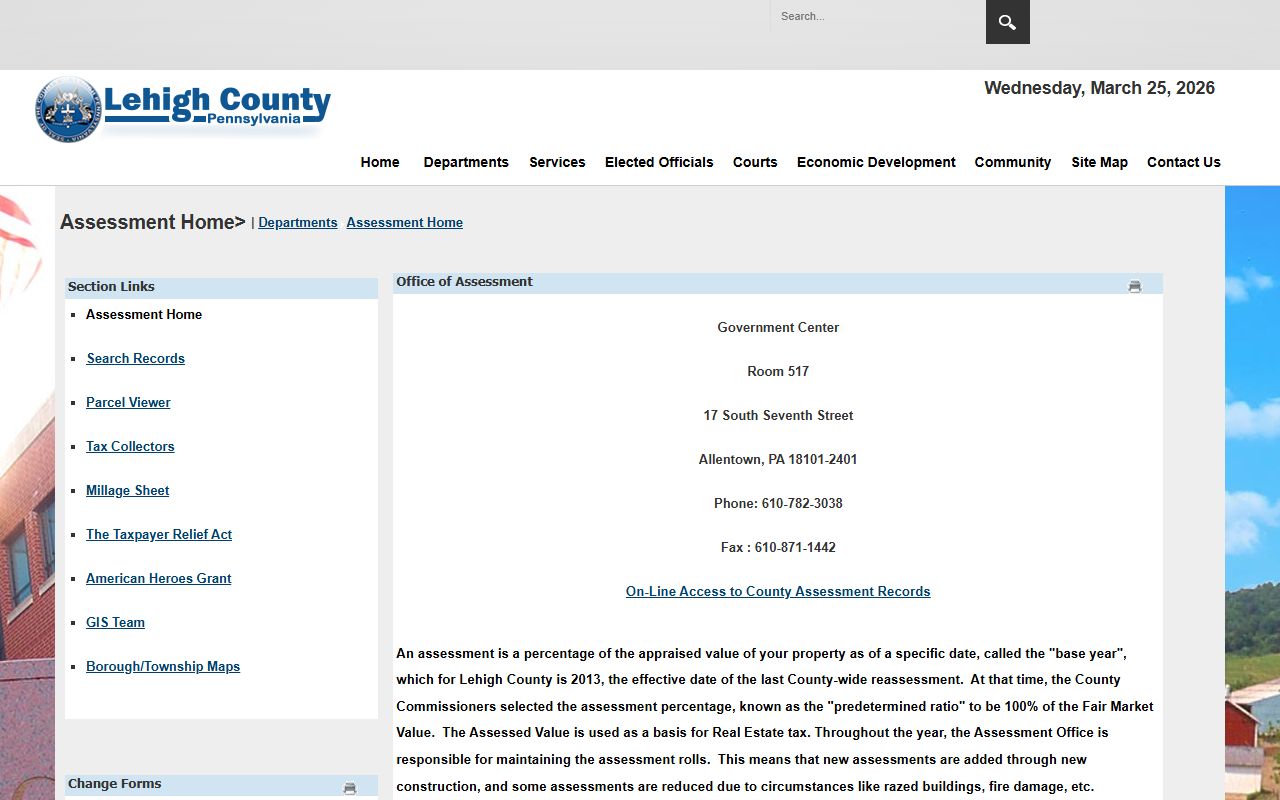
The Assessment Office provides forms including the Address Change Form, Surviving Owner Change Form, Appeal Form for All Properties, and Attorney Authorization, along with archived Board of Assessment Appeals agendas dating back several years.
Note: Filing fees for appeals were updated as of February 6, 2023, per County of Lehigh Ordinance No. 2023-101; confirm current fees directly with the Assessment Office before submitting an appeal.
How to Search Lehigh County Property Tax Records
The Lehigh County Assessment Office website provides online and in-person access to Lehigh County property tax records. The county website at lehighcounty.org/Departments/Assessment is the primary starting point for online access, forms, and procedural information. Users can search by address, parcel identification number, or owner name depending on available tools. The search system returns assessed values, ownership details, and related tax data for individual parcels across the county.
In-person assistance is available at Room 517 in the Government Center, 17 South 7th Street, Allentown, during regular business hours. Office staff can help with property record card requests, explain how an assessed value was determined, describe current exemptions or program enrollments on a parcel, and guide property owners through the appeal process. Calling ahead at (610) 782-3038 is a good way to confirm hours and confirm what documents to bring.
Property record cards are among the most useful documents for property research. Each card documents the parcel's physical characteristics, including land area, building dimensions, construction type, condition, and year built. These characteristics feed directly into the assessed value calculation. Reviewing your property record card is often the first step in evaluating whether an assessment is accurate.
Pennsylvania's Right-to-Know Law establishes that public records are presumed accessible. A formal written request to the county's Open Records Officer is available if standard access methods do not produce the information needed. Government agencies are generally required to respond within five business days. The statewide PA county assessment office directory lists Lehigh County among all 67 Pennsylvania counties and links to county-level resources.
Lehigh County Assessment Methodology and Base Year
Lehigh County uses 2013 as its base year for property assessments. All assessed values in the county reflect 100% of the property's Fair Market Value as of that year. Fair Market Value is the price a willing buyer would pay a willing seller in an open, arm's length transaction without undue pressure from either side. Because the base year is fixed at 2013, current market prices will often differ from assessed values. This difference alone is not grounds for an appeal.
The predetermined ratio of 100% means the county intends assessed value and base-year market value to be equal. In practice, this ratio is used to evaluate whether a property is uniformly assessed relative to comparable parcels. Pennsylvania's Uniformity Clause, a constitutional requirement, mandates that all properties of the same class be taxed at the same ratio. If evidence shows that a property's effective assessment ratio differs materially from the countywide common level ratio, that disparity can form the basis of a successful appeal. The PA Consolidated Statutes, Title 72, establishes the statutory framework for property taxation across all 67 Pennsylvania counties, including Lehigh.
New construction completed after 2013 is assessed at the time improvements are finished, using 2013 as the valuation standard. Properties that are partially or fully destroyed receive reductions reflecting the loss of improvements. These interim changes maintain a current, accurate roll between full countywide reassessments.
Filing a Lehigh County Property Tax Assessment Appeal
Property owners who believe their assessed value does not accurately reflect the 2013 Fair Market Value of their property have the right to appeal. The Lehigh County Board of Assessment Appeals hears formal challenges. Taxing bodies such as school districts and municipalities also have standing to appeal assessments they consider too low. Both sides use the same process.
The annual filing deadline is August 1 of each year. All appeals must be original signed documents received at the Assessment Office on or before that date, along with the applicable filing fee. An Interim Appeal may also be filed by the date specified on any Change of Assessment Notice issued by the office during the year. Deadlines are strictly enforced.
A critical point for Lehigh County filers: postmarks are not accepted as evidence of timely filing, and faxed appeals are not accepted under any circumstances. The signed original must physically arrive at the Assessment Office by the deadline. Property owners who are near the deadline should consider hand-delivering their appeal rather than relying on mail. All appeal forms are available at lehighcounty.org/Departments/Assessment, including the Appeal Form for All Properties, the Hearing Request to Re-Schedule or Withdraw, and the Attorney Authorization form.
Strong appeals are supported by relevant evidence. For a Lehigh County property, useful evidence includes comparable sales from the 2013 base year period, an independent appraisal using 2013 as the effective date, photographs documenting property defects or conditions, and prior assessments or listing history. Board decisions may be further appealed to the Lehigh County Court of Common Pleas under the framework established by Title 72 of the Pennsylvania Consolidated Statutes.
Note: Because postmarked and faxed appeals are not accepted, property owners must ensure physical delivery of original signed documents to the Assessment Office before August 1.
Lehigh County Clean and Green Preferential Assessment
Lehigh County administers the Clean and Green preferential assessment program for qualifying agricultural and forested land. Detailed information, eligibility requirements, and enrollment forms are available at lehighcounty.org/Departments/Assessment/Clean-and-Green. The program is one of the most significant property tax relief tools available to landowners in the county, particularly for those maintaining working farms or managing forest reserve parcels.
The image below comes from the Lehigh County Clean and Green program page, illustrating the county's resources for landowners considering preferential assessment enrollment.
Enrollment in Clean and Green can substantially reduce the assessed value used for tax calculations on qualifying land, making it an important planning tool for agricultural landowners in Lehigh County.
Clean and Green was established under Act 319 of 1974. It provides preferential assessment at use value rather than Fair Market Value for qualifying parcels. To qualify in Lehigh County, a property must contain at least 10 contiguous acres devoted to Agricultural Use, Agricultural Reserve, or Forest Reserve. Properties smaller than 10 acres may also qualify if they are capable of generating at least $2,000 or more in annual farm income. More than 9.3 million acres are enrolled statewide, reflecting broad adoption across Pennsylvania. Enrolled landowners must comply with program use requirements; if land is converted to a non-qualifying use, rollback taxes covering up to seven prior years are assessed, along with interest.
Property Tax Relief Programs in Lehigh County
Several additional relief programs are available to Lehigh County property owners. The Pennsylvania Property Tax and Rent Rebate program, administered by the PA Department of Revenue, provides annual rebates to eligible seniors aged 65 and older, widows and widowers aged 50 and older, and disabled individuals aged 18 and older. The rebate amount is income-based and is funded through lottery and gaming revenues. Applications are filed each year with the Department of Revenue.
The Homestead Exclusion under Act 72 of 2004 reduces the assessed value of a qualifying owner-occupied primary residence before school property taxes are calculated. Homeowners in Lehigh County must apply through the Assessment Office to designate their property as a homestead. New owners should contact the office promptly after purchase to enroll. The Farmstead Exclusion extends similar relief to qualifying farm buildings on agricultural properties where the owner resides. Together, these exclusions can meaningfully reduce annual school property tax bills for eligible households.
The Pennsylvania Department of Community and Economic Development supports county and local governments in administering tax programs and other public services. For questions about current tax bills, payment options, or delinquent accounts, the Lehigh County Treasury Department at lehighcounty.org/Departments/Treasury is the appropriate contact.
Lehigh County Treasury and Tax Payment Records
The Lehigh County Treasury Office manages billing, collection, and delinquency for county property taxes. Property owners with questions about tax bills, payment deadlines, installment payment plans, or delinquent tax balances should contact Treasury directly. The Treasury also provides tax certifications needed for real estate closings, showing the current status of tax obligations on a given parcel.
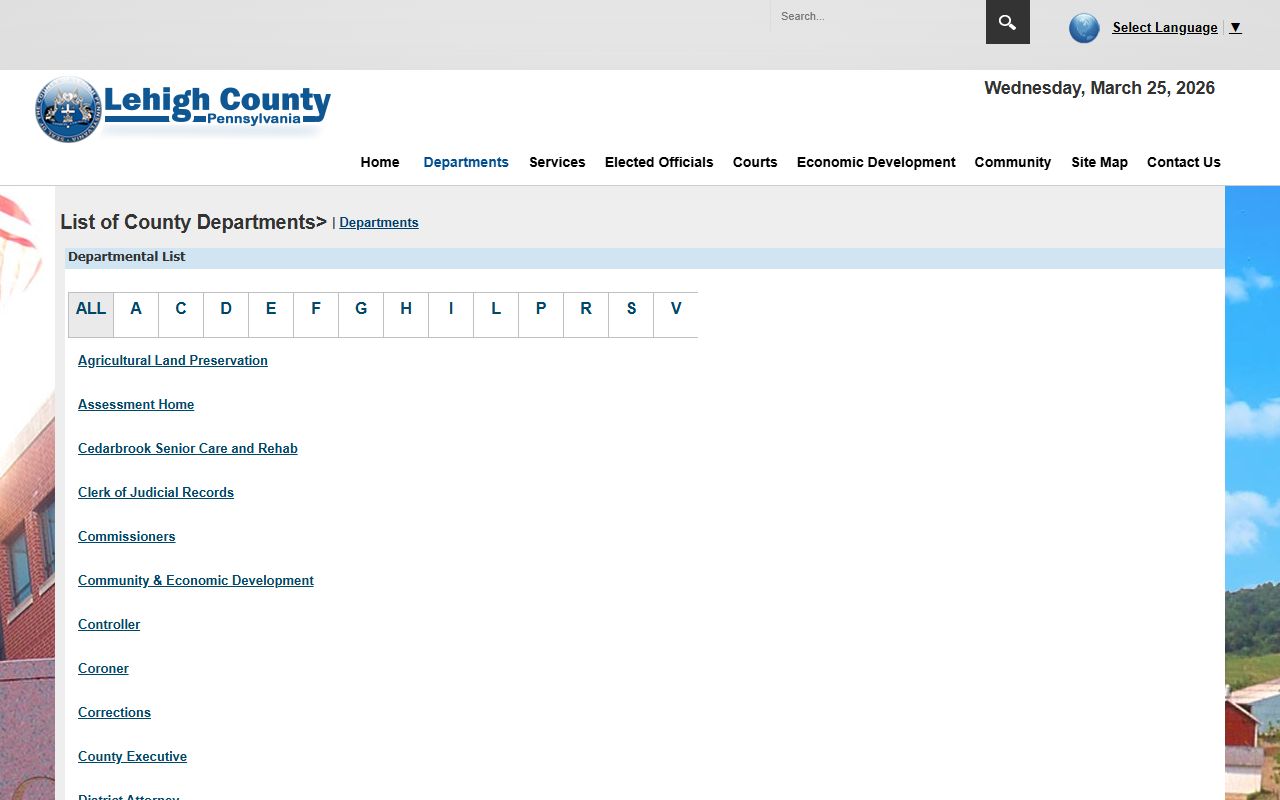
The image below is from the Lehigh County Treasury Department page, which provides resources for tax payments and account status inquiries.
The Treasury and the Assessment Office work in coordination, as assessed values determined by the Assessment Office flow directly to Treasury for use in calculating annual tax bills.
Property taxes in Lehigh County are levied by three layers of government: the county, the municipality where the property is located, and the local school district. Each taxing body sets its own millage rate annually through its budget process. County and municipal tax bills may arrive at different times of year, and school district bills are typically the largest of the three. For a full picture of the annual tax burden on any Lehigh County parcel, all three layers must be considered. Delinquent property taxes accrue interest and penalties over time and can ultimately result in tax sale proceedings if left unresolved.
Lehigh County Recorder of Deeds and Land Records
The Lehigh County Recorder of Deeds maintains the official public record of all real property instruments filed in the county. Deeds, mortgages, satisfactions, mechanics' liens, and other title-affecting documents are indexed and preserved here. Any change in ownership of Lehigh County real property is documented through the Recorder's office, making it an essential resource for title research, ownership verification, and lien searches.
Recorded documents are public records under Pennsylvania's Right-to-Know Law. Title companies, lenders, attorneys, and buyers rely on the Recorder's index to trace ownership histories and identify outstanding encumbrances. The Assessment Office uses deed information to update ownership records on the assessment roll. When a property changes hands and a new deed is recorded, that information flows from the Recorder's office to the Assessment Office for roll maintenance. Keeping both offices informed supports accurate and timely record updates across the county.
Lehigh County's active real estate market, driven by the economic strength of the Lehigh Valley, generates a large volume of recorded instruments each year. Together, the Assessment Office and the Recorder of Deeds provide the primary sources of property information in the county. The Assessment Office establishes value for tax purposes; the Recorder documents the legal history of ownership and encumbrances. Reviewing both is essential for thorough property research in Lehigh County. The PA Consolidated Statutes establish the legal framework governing both recording requirements and property taxation statewide.
Cities in Lehigh County
Allentown is the county seat and Pennsylvania's third-largest city, serving as the primary urban center for Lehigh County property tax and assessment activity. Bethlehem, one of Pennsylvania's most historically significant cities, straddles the border between Lehigh and Northampton Counties.
Nearby Counties
Lehigh County is surrounded by five Pennsylvania counties in the eastern part of the state, each maintaining its own assessment office and property tax records system.