
Erie County Pennsylvania Property Tax Records
Erie County occupies the northwestern corner of Pennsylvania along the southern shore of Lake Erie, giving the county a distinctive geography and a regional economy anchored by the city of Erie. The county's Assessment Office maintains property tax records for all real estate within its borders, from urban parcels in the city of Erie to lakefront properties and rural agricultural tracts in the outlying townships. Online search tools at eriecountypa.gov make it straightforward to look up Erie County property tax records by address or parcel number. This guide covers the available search methods, what property records contain, and how to pursue relief or appeal options.
Erie County Quick Facts
Erie County Assessment Office
The Erie County Assessment Office is located at the Erie County Courthouse, Room 104, at 140 West 6th Street in the city of Erie. This office is responsible for establishing and maintaining assessed values for all taxable real property throughout the county, including the city, surrounding boroughs, and rural townships. Staff maintain property record cards, tax maps, and the official assessment rolls that local taxing bodies use to calculate tax bills each year. Pennsylvania's property tax system operates under Title 72 of the PA Consolidated Statutes, and the Erie County Assessment Office carries out its statutory duties within that framework. The PA Department of Community and Economic Development provides guidance to county offices on assessment methodology and data management.
Erie County's GIS Department at eriecountypa.gov/departments/gis maintains spatial data that complements the Assessment Office's parcel records, offering interactive mapping capabilities that let users visualize property boundaries and attributes in a geographic context. The Revenue and Tax Claim Bureau handles delinquent tax matters, including conducting tax sales for properties where obligations have gone unpaid. Together these departments provide comprehensive coverage of the county's property tax administration needs.
The Erie County Assessment Office provides property search tools, assessed values, and records for all parcels within Erie County, Pennsylvania.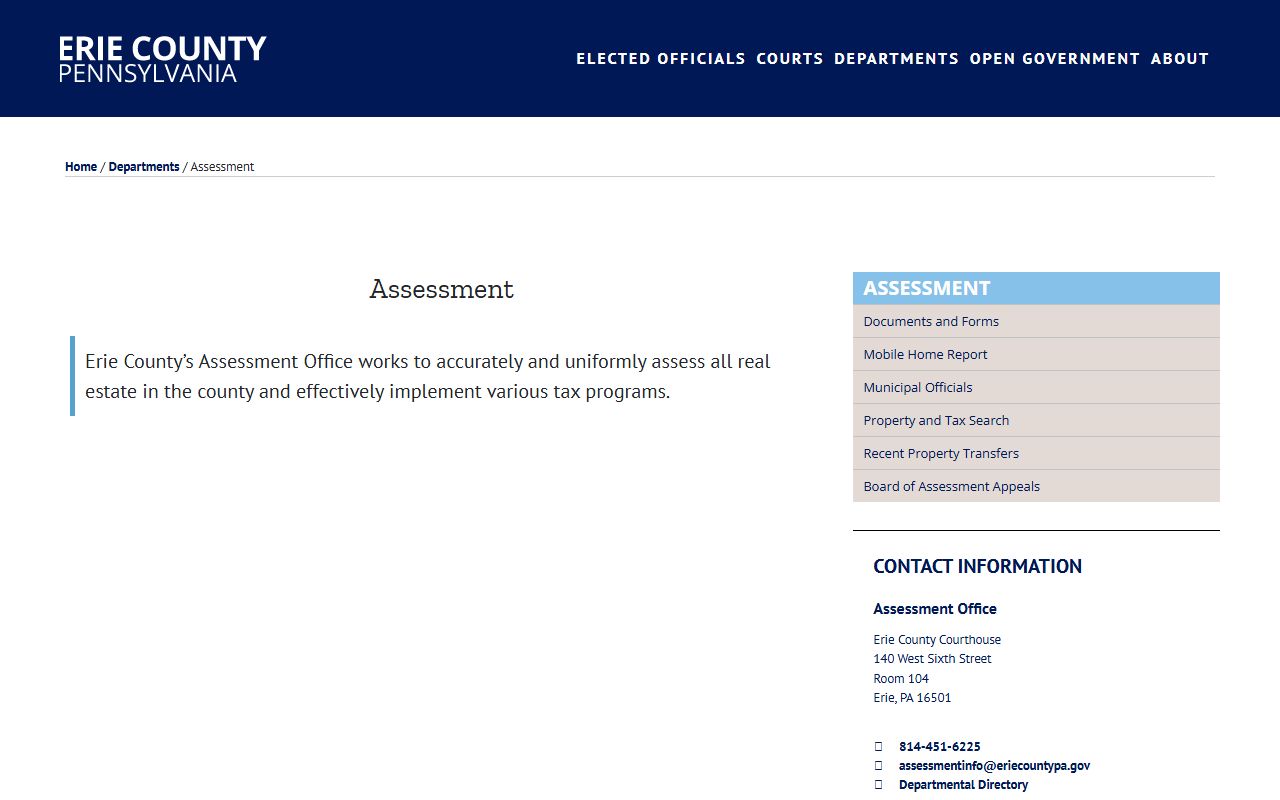
Erie County's Assessment Office at the courthouse in Erie processes assessment records, appeals, and property data requests for the entire county.
| Office | Erie County Courthouse, 140 West 6th St., Room 104, Erie, PA 16501 |
|---|---|
| Phone | (814) 451-6225 |
| Fax | (814) 451-6094 |
| Website | eriecountypa.gov/departments/assessment |
Note: The Erie County Revenue and Tax Claim Bureau at eriecountypa.gov/departments/revenue-and-tax-claim-bureau handles delinquent tax matters and should be contacted separately from the Assessment Office for payment or tax sale questions.
Searching Erie County Property Tax Records Online
Erie County's online property search at eriecountypa.gov/departments/assessment allows users to look up parcels by street address or parcel number. The system returns current assessed values, ownership information, and property characteristics for each matched record. A property sales search feature lets users narrow results by municipality and date range, which is particularly useful for identifying recent comparable sales when preparing an assessment appeal.
The GIS Department provides an interactive mapping tool that overlays parcel boundaries on aerial imagery, giving researchers a geographic view of any property in the county. This is especially useful for lakefront properties and rural tracts where lot boundaries are not obvious from an address alone. For deed and ownership history research, the Recorder of Deeds at eriecountypa.gov/departments/recorder-of-deeds provides recorded instrument access. Pennsylvania's Right-to-Know Law ensures that assessment records are presumed public, and the PA county assessment directory lists access options for all 67 counties for comparative research needs.
In-person access at Room 104 of the courthouse remains available for those who prefer direct staff assistance or need to review records that are not fully accessible through the online portal. Written mail requests are also accepted.
Erie County Property Tax Records: What They Include
Property records maintained by the Erie County Assessment Office document each parcel's identification number, assessed value, owner of record with mailing address, and a physical description of any improvements. For residential properties, this includes the year of construction, total living area, number of stories, construction type, number of bedrooms and bathrooms, and condition rating. Commercial and industrial records carry additional information about use type and property characteristics relevant to income-producing real estate.
Erie County's property base spans a diverse range of types. The city of Erie contains dense urban residential and commercial parcels, while the surrounding townships feature suburban subdivisions, agricultural land, and properties along the Lake Erie shoreline. Lakefront properties often carry premium assessed values reflecting their desirable location. According to propertytax101.org, Pennsylvania's median property tax is roughly $2,223 on a median home value of $164,700, representing about 1.35 percent of home value statewide. The PA State Data Center publishes regional economic and demographic data that can provide helpful context when evaluating Erie County property assessments within the northwestern Pennsylvania market.
Tax maps maintained by the Assessment Office and the GIS Department show parcel configurations and boundaries across the county. These maps are essential for boundary research, subdivision analysis, and understanding how neighboring parcels are configured relative to any property under review.
Note: Assessed values in Erie County reflect a percentage of estimated market value, and the county's common level ratio should be consulted when comparing assessed values to recent sale prices or preparing appeal documentation.
Erie County Assessment Appeals Process
Property owners who believe their Erie County assessment is inaccurate may file a formal appeal with the Board of Assessment Appeals. The standard annual deadline is August 1 under Pennsylvania law. Missing this date typically means waiting until the following filing period unless a specific triggering event such as a recent sale or newly constructed improvement creates a separate review window.
A well-prepared appeal should include the current property record card, recent comparable sales data from similar Erie County properties, and an independent appraisal from a licensed Pennsylvania appraiser when the amount at issue justifies that expense. The burden of proof rests with the appealing property owner to demonstrate that the assessed value is unreasonable. Pennsylvania's Uniformity Clause in Article VIII, Section 1 of the state constitution supports appeals where a property can be shown to be assessed at a higher ratio than comparable parcels. If the Board of Assessment Appeals does not resolve the matter satisfactorily, further appeal is available at the Court of Common Pleas through the PA Courts system. The Tax Foundation's Pennsylvania overview provides useful background on how Pennsylvania's property tax structure compares to other states.
Property Tax Relief Programs in Erie County
Several programs are available to reduce property tax burdens for qualifying Erie County owners. The Homestead Exclusion under Act 1 of 2006 reduces the assessed value of an owner-occupied primary residence before millage rates are calculated. The Farmstead Exclusion under Act 72 of 2004 provides comparable relief for agricultural buildings on actively farmed properties. Both require applications through the Erie County Assessment Office and periodic recertification.
Agricultural landowners in Erie County's rural townships may qualify for Clean and Green preferential assessment under Act 319 of 1974. This program values qualifying farmland and forest land at use value rather than market value, potentially reducing assessed values significantly for large rural tracts. To qualify, a parcel must be at least 10 acres or generate a minimum of $2,000 in annual farm income. More than 9.3 million acres statewide are enrolled in Clean and Green, reflecting its importance to Pennsylvania's agricultural economy. Property owners interested in enrollment should contact the Assessment Office for application details and information about rollback taxes that apply if the land is later converted to a non-qualifying use.
The PA Department of Revenue administers the Property Tax/Rent Rebate Program, providing rebates to qualifying seniors age 65 and older, widows and widowers age 50 and older, and disabled individuals age 18 and older who meet income requirements. Applications are accepted annually through June 30. Erie County residents can access application forms through the county's offices or directly from the Department of Revenue's website.
Erie County Recorder of Deeds and Land Records
The Erie County Recorder of Deeds maintains the official land records for the county, including deeds, mortgages, liens, and other instruments affecting real property titles. Every property conveyance and encumbrance in Erie County must be recorded with this office to establish public notice, creating the chain of title that supports every real estate transaction in the county. Access to these records is available through eriecountypa.gov/departments/recorder-of-deeds.
The Recorder's office provides online access to indexed recorded documents, allowing title researchers, attorneys, and lenders to search by party name, document type, or date range without visiting the courthouse. In-person research at the Erie County Courthouse is also available for documents that predate digital indexing or require physical review. Certified copies of recorded instruments can be obtained for a fee and are commonly needed for estate administration, legal proceedings, and refinancing transactions. Pennsylvania's Right-to-Know Law confirms that recorded land documents are public records. The combination of the Recorder of Deeds records and the Assessment Office's parcel data gives researchers a complete picture of any Erie County property's ownership history and current tax status.
Note: Land records reflect transactions as of their recording date, so recently closed sales may not appear in the searchable database immediately after the closing occurs.
Cities in Erie County
Erie County is home to the city of Erie, the county seat and Pennsylvania's fourth largest city, located directly on the southern shore of Lake Erie.
Nearby Counties
Erie County borders Crawford and Mercer counties in Pennsylvania, as well as Ohio to the west and New York to the east. Explore property tax records in neighboring jurisdictions below.