
Cumberland County Property Tax Records and Real Estate Assessments
Cumberland County is located in south-central Pennsylvania, with Carlisle as its county seat and much of its population centered in the suburban communities surrounding Harrisburg. The county has seen sustained growth as a desirable residential location within commuting distance of the state capital, with an active real estate market that makes accurate property assessment information especially valuable. The Cumberland County Assessment Office maintains property records for all taxable real estate in the county, and the Recorder of Deeds holds the official land records archive. This guide covers the key resources, processes, and programs relevant to Cumberland County property tax records.
Cumberland County Quick Facts
Cumberland County Assessment Office
The Cumberland County Assessment Office is based at the Cumberland County Courthouse in Carlisle and is responsible for valuing all taxable real property in the county. Staff maintain property record cards for every parcel, documenting ownership, physical characteristics, land use classification, and current assessed values. These records form the foundation for all property tax billing by the county, its municipalities, and school districts. The county's website at cumberlandcountypa.gov provides information on available services and how to access property records online and in person.
Pennsylvania property tax administration is governed by Title 72 of the Pennsylvania Consolidated Statutes, available at palegis.us/statutes/consolidated. This comprehensive body of law establishes the framework within which Cumberland County's Assessment Office must operate, covering valuation methodology, appeal procedures, and eligibility requirements for exemption programs. As one of the more active real estate markets in central Pennsylvania, Cumberland County's assessment office handles a high volume of new construction, ownership transfers, and assessment inquiries each year.
The Pennsylvania Department of Community and Economic Development supports county governments statewide with guidance and technical resources for property assessment administration. Cumberland County benefits from this statewide network as it works to maintain accurate and uniform valuations across its growing suburban and rural landscape.
| Office | Cumberland County Courthouse, Carlisle, PA |
|---|---|
| Website | https://www.cumberlandcountypa.gov/ |
Note: Cumberland County's active real estate market means assessed values can be an important factor in purchase decisions, making the online resources available through the county website particularly useful for buyers researching specific properties.
Searching Cumberland County Property Tax Records
Cumberland County provides multiple options for accessing property tax records. The county's website at cumberlandcountypa.gov offers online information about assessment data and property records, making it possible to conduct preliminary research without visiting the courthouse. In-person searches at the Assessment Office allow access to detailed property record cards by owner name, address, or parcel number, and staff can assist with more complex inquiries.
The Cumberland County government website at cumberlandcountypa.gov provides information about property records, assessment data, and county services for residents of this south-central Pennsylvania county.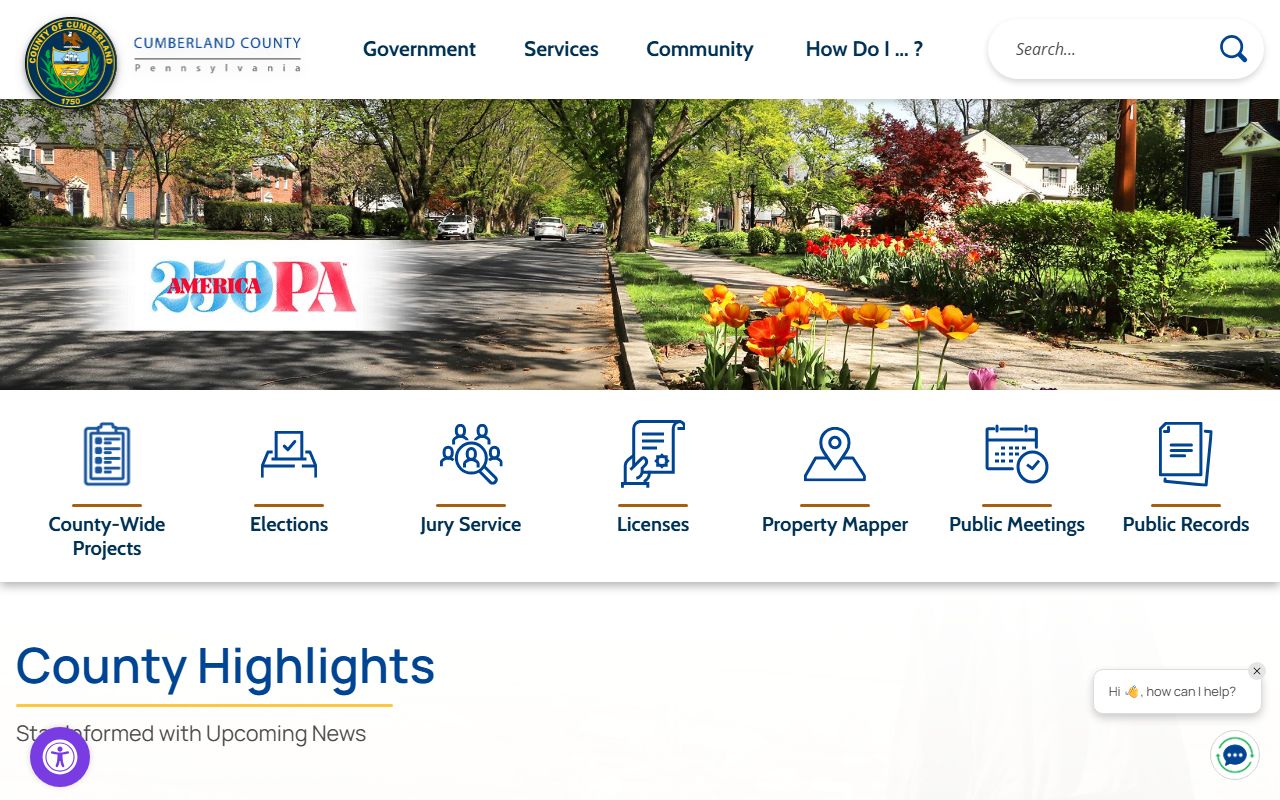
The Cumberland County Assessment Office in Carlisle maintains comprehensive property records for one of south-central Pennsylvania's most active real estate markets.
Pennsylvania's Right-to-Know Law confirms that assessment records are presumed public and accessible to all. The Office of Open Records at openrecords.pa.gov administers this law and explains the process for submitting formal records requests. For statewide context, propertytax101.org notes that Pennsylvania's median property tax is approximately $2,223 on a median home value of $164,700. Cumberland County's suburban Harrisburg location and strong real estate market often mean property values and corresponding tax obligations that exceed the statewide median for many residential parcels.
The directory at publicrecords.onlinesearches.com provides an overview of how Pennsylvania county assessment offices organize public access to property records, which can be helpful for researchers comparing approaches across different counties.
What Cumberland County Property Tax Records Contain
Property records maintained by the Cumberland County Assessment Office provide a detailed profile of each taxable parcel. A standard property record card includes the current owner's name and mailing address, the physical address and location of the property, lot size and dimensions, land use classification, building type and square footage, year of construction, and the current assessed value. For new construction in Cumberland County's growing residential communities, the Assessment Office updates records as building permits are issued and construction is completed.
Cumberland County's suburban Harrisburg character means a high proportion of its parcels are residential properties in planned developments, established neighborhoods, and newer subdivisions. The county also includes agricultural areas in its more rural portions, particularly in its western and northern townships. This mix creates a diverse assessment landscape where residential market dynamics in suburban communities coexist with agricultural valuation considerations in rural areas.
The State Tax Equalization Board monitors assessment levels across all Pennsylvania counties to ensure uniformity under the Uniformity Clause of Article VIII, Section 1 of the Pennsylvania Constitution. For an active market like Cumberland County, where sales are frequent and property values have risen steadily, maintaining the appropriate relationship between assessed values and market values is an ongoing consideration. Data from the Pennsylvania State Data Center and the Tax Foundation provide additional context for understanding how Cumberland County's property tax levels compare to statewide patterns.
Cumberland County Assessment Appeals
Property owners in Cumberland County who believe their assessed value does not accurately reflect market conditions may file an appeal with the Board of Assessment Appeals. The standard annual appeal deadline is August 1, with successful appeals taking effect for the following tax year. Owners who receive a notice of change in their assessed value may also appeal within 40 days of receiving that notice.
Given Cumberland County's active real estate market, comparable sales data is often readily available for residential properties in the county's suburban communities. A strong appeal typically includes recent sales of similar properties in the neighborhood, an independent appraisal, or documentation of physical errors in the property record. The Assessment Office can provide guidance on the forms required to initiate an appeal and the evidence standards that apply before the Board.
Property owners who are not satisfied with the Board's decision may pursue further review through the Pennsylvania Courts system. The Court of Common Pleas provides judicial review of Board determinations, ensuring that every property owner in Cumberland County has meaningful recourse when they believe an assessment is inaccurate or inconsistent with comparable properties. The constitutional basis for this right is the Uniformity Clause, which mandates equal treatment for all properties of the same class within the county.
Note: In an active market like Cumberland County, recent comparable sales data is often the most persuasive evidence in an assessment appeal because up-to-date sales reflect current market conditions clearly.
Property Tax Relief Programs in Cumberland County
Several programs can reduce property tax obligations for qualifying Cumberland County residents. The Homestead Exclusion under Act 72 of 2004 provides a reduction in the taxable assessed value of a primary residence. Property owners apply through the Assessment Office and, once enrolled, do not need to reapply unless the property changes hands. School districts and the county each set their own exclusion amounts, and the combined benefit can meaningfully reduce annual tax bills for primary homeowners throughout Cumberland County's suburban communities.
The Clean and Green preferential assessment program under Act 319 of 1974 applies to qualifying agricultural and forestry land. More than 9.3 million acres across Pennsylvania are currently enrolled in this program. Properties must be at least 10 acres or generate at least $2,000 in annual farm income to qualify. Applications are submitted before June 1 for the following year. While Cumberland County is predominantly suburban near Harrisburg, the county's rural western and northern portions include working farms and forested tracts where Clean and Green can provide significant tax relief by valuing land based on agricultural use rather than development potential.
Senior residents aged 65 and older may qualify for the Property Tax and Rent Rebate Program through the Pennsylvania Department of Revenue. This program provides annual rebates based on household income and property taxes paid, delivering targeted relief to older homeowners throughout Cumberland County. Given the county's suburban character and higher-than-average property values, this program can offer meaningful assistance to seniors managing housing costs on fixed incomes. Applications are filed annually with the state.
The Farmstead Exclusion provides additional relief for actively farmed properties beyond the Homestead program, reducing the assessed value of qualifying farm buildings and improvements. Cumberland County's Assessment Office manages enrollment for all relief programs, and staff can assist property owners with questions about eligibility and the application process for any of these programs.
Cumberland County Recorder of Deeds
The Cumberland County Recorder of Deeds maintains the official repository of land records for the county, recording and indexing deeds, mortgages, liens, easements, and other instruments affecting real property. Cumberland County's active real estate market generates a high volume of recorded documents each year, and the Recorder's office is a frequent resource for buyers, sellers, lenders, attorneys, and title researchers conducting due diligence on property transactions throughout the county.
When a property is sold or a mortgage is placed on real estate in Cumberland County, the transaction documents must be recorded with the Recorder of Deeds to create a public record. This recording system establishes the chain of title that protects all parties with an interest in the property. The Recorder of Deeds information is available through the county website at cumberlandcountypa.gov.
Pennsylvania's Right-to-Know Law, administered by the Office of Open Records, ensures that all recorded land documents are accessible to the public. Many active counties like Cumberland have developed online access tools for deed indexes and document images, making it possible to conduct significant research without a courthouse visit. Checking the county website for currently available online tools is a practical first step before planning an in-person research visit to the Recorder's office in Carlisle.
Nearby Counties
Cumberland County borders four counties in south-central Pennsylvania, each with its own property records system serving the surrounding communities.