
Scranton Property Tax Records and Assessment Information
Scranton is the county seat of Lackawanna County and the largest city in northeastern Pennsylvania. The Lackawanna County Assessment Office handles all property valuations for parcels within Scranton, while the city's Bureau of Treasury oversees local tax collection and financial management. Residents searching Scranton property tax records can access ownership details, assessed values, and parcel data through the county's online tools and can contact city or county offices directly for account-specific questions.
Scranton Quick Facts
How Scranton Property Assessments Work
In Scranton, property tax assessments are the responsibility of the Lackawanna County Assessment Office rather than the city government. The Assessment Office is located at The Scranton Electric Building, 135 Jefferson Avenue, Scranton, PA 18503, and can be reached at (570) 963-6728. Full information about county assessment services is available through the Lackawanna County website at lackawannacounty.org. The office values every parcel in the county including those within Scranton's city limits, setting the assessed values that form the basis for all property tax calculations.
The county applies mass appraisal methods to value Scranton's diverse property inventory. Assessors analyze comparable sales, physical property data, and neighborhood market trends to determine each parcel's taxable value. Scranton's real estate market spans historic residential districts, older commercial corridors, industrial sites with redevelopment potential, and newer construction, all of which require distinct valuation approaches. The assessed value assigned by the county is then multiplied by the applicable millage rates for the county, the city, and the Scranton School District to produce the annual tax bill for each property owner.
The city collects property taxes based on Lackawanna County's assessed values. The relationship between the county assessment office and city tax collection means that property owners in Scranton sometimes need to work with both offices: the county for valuation questions and the city for billing, payment, and collection matters. Understanding this division helps residents reach the right office more quickly when questions or disputes arise about a specific tax account.
Note: Scranton received $68.7 million from the American Rescue Plan Act, a portion of which has supported city investments that may affect neighborhood property values and the local tax base over time.
Searching Scranton Property Tax Records Online
The Lackawanna County online parcel system is the primary tool for searching Scranton property tax records. Through the county portal at lackawannacounty.org, users can search by street address or parcel identification number to retrieve current ownership information, assessed values, and property characteristics for any Scranton parcel in the county database. The system draws directly from assessment office records, so the data reflects the county's current valuations.
The city of Scranton's official website provides residents with local government contacts, department directories, and resources connected to property ownership and tax accounts in the city.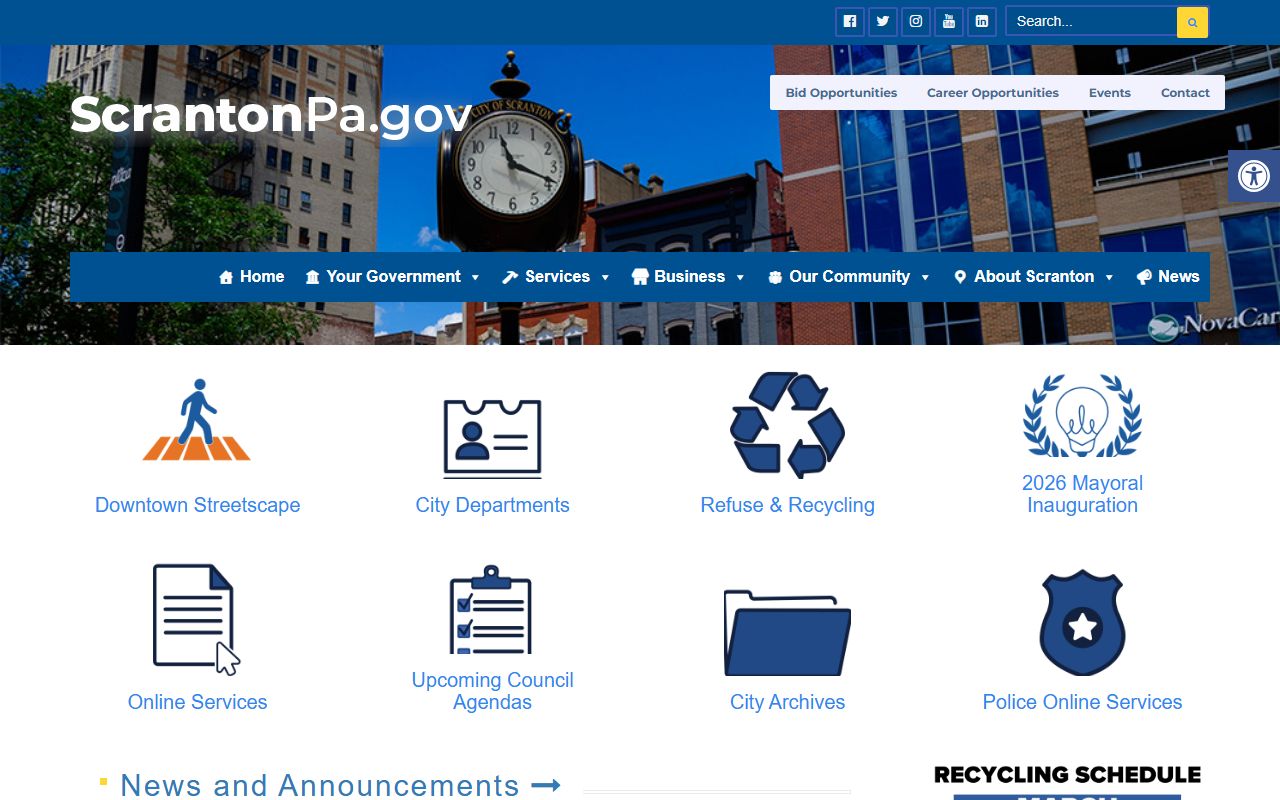
The city site connects Scranton property owners to the Bureau of Treasury and other departments that handle tax collection, billing inquiries, and related municipal services.
The county's GIS mapping tools, where available, allow users to locate parcels by clicking on an interactive map rather than entering an address. This method is useful when searching for a property whose exact address is uncertain or when reviewing a cluster of parcels in a specific block or neighborhood. Once a parcel is selected, the system displays the assessment data, legal description, and any sales history linked to that parcel number in the county system.
For records not available through county portals, the Pennsylvania Office of Open Records outlines how to submit a formal Right-to-Know request to access public records from Lackawanna County or the city of Scranton. All property assessment records are presumed public under Pennsylvania law, making this a reliable fallback option when standard online searches do not return the needed information.
Scranton Bureau of Treasury and City Tax Collection
The Scranton Bureau of Treasury manages the collection and disbursement of public funds for the city, including property tax revenues. The Bureau is reachable at 570.348.4107 and by email at treasury@scrantonpa.gov, with office hours of Monday through Friday, 8:00 AM to 4:30 PM. More information about city treasury functions is available through the Scranton Treasury Department page at the city's website.
The Scranton Bureau of Treasury oversees city tax collection and collaborates with contracted tax collectors serving Scranton property owners.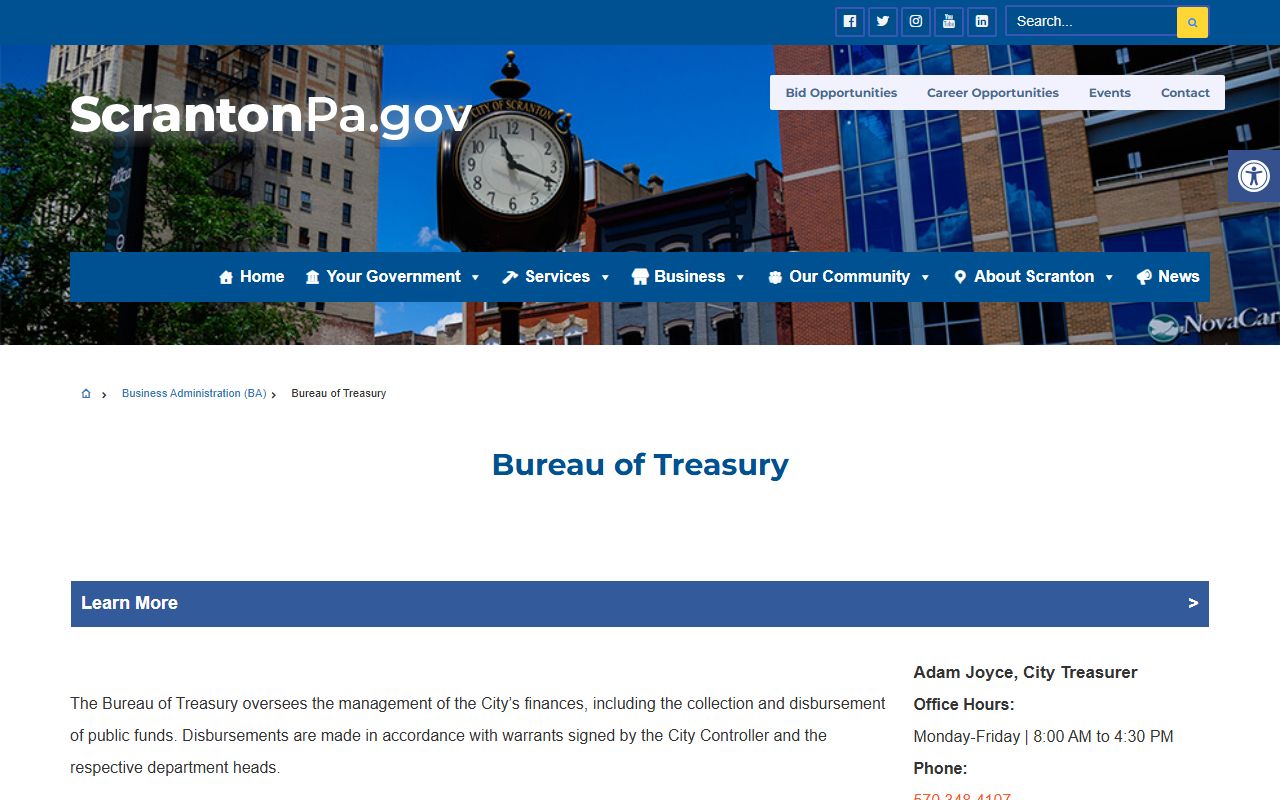
The City Treasurer also serves on the Lackawanna County Land Bank Board, connecting city financial oversight to broader county efforts around property revitalization and tax-delinquent land management.
The Bureau of Treasury works with contracted tax collectors to handle the practical aspects of collecting property taxes from Scranton residents and property owners. This collaborative model means that some billing and collection functions may be handled by a contracted entity on behalf of the city rather than directly by Bureau staff. Contacting the Bureau directly is the best first step when you have questions about a specific Scranton tax account, payment history, or the correct collector responsible for your property.
The City Treasurer's involvement with the Lackawanna County Land Bank Board reflects Scranton's broader effort to address properties with delinquent taxes and promote the return of vacant or abandoned parcels to productive use. The Land Bank acquires tax-delinquent properties and works to transfer them to new owners who will invest in their improvement, which can affect assessed values and tax revenues in surrounding neighborhoods over time.
Note: When contacting the Bureau of Treasury about a tax balance, have your parcel number or property address ready so staff can pull your account records promptly during the call.
In-Person Access to Scranton Property Records
Residents who prefer in-person assistance with Scranton property tax records can visit the Lackawanna County Assessment Office at The Scranton Electric Building, 135 Jefferson Avenue, Scranton, PA 18503. Staff at the office can retrieve parcel records, explain assessed values, and help property owners understand the data in their county file. The office is open during standard weekday business hours, and walk-in visitors are generally assisted without a prior appointment.
The Lackawanna County Recorder of Deeds maintains official deed records, mortgages, and other recorded legal instruments for all Scranton properties. These documents establish the chain of title and identify any encumbrances on a parcel such as liens or easements. Deed records are open to the public and can be reviewed in person or ordered as certified copies for use in transactions or legal proceedings. The Recorder of Deeds office is also located in Scranton, making it convenient to visit both the Assessment Office and the Recorder on the same trip if needed.
The city's Bureau of Treasury, reachable at 570.348.4107 and accessible through scrantonpa.gov, handles in-person inquiries about tax payments, outstanding balances, and account history for city tax accounts. The Treasury office at city hall is separate from the county Assessment Office, so residents should plan their visit to the appropriate office based on whether the question involves assessed value or tax billing and collection.
Scranton Property Tax Assessment Appeals
Scranton property owners who believe their Lackawanna County assessment is inaccurate can file a formal appeal with the Lackawanna County Board of Assessment Appeals. The board provides an independent review of contested property valuations and operates separately from the Assessment Office to ensure objectivity in the review process. Pennsylvania's standard August 1 filing deadline applies in Lackawanna County, giving property owners time each summer to gather evidence and prepare their submission.
The most effective appeals are supported by concrete market evidence. Recent comparable sales of similar properties in the same Scranton neighborhood are the strongest form of documentation, as they directly show what buyers have paid for properties resembling yours in size, condition, age, and location. A licensed appraisal from a credentialed professional carries significant weight as well, particularly for commercial or multi-family properties where finding close comparables requires specialized market knowledge. Factual errors in the county's recorded property data, such as incorrect room counts or wrong building dimensions, also provide grounds for appeal and can be corrected through the formal process.
The Pennsylvania Consolidated Statutes establish the framework for assessment appeals across all 67 counties, including the evidentiary standards boards must apply when reviewing cases. Property owners who disagree with the Board of Assessment Appeals decision can escalate their case to the Lackawanna County Court of Common Pleas for additional judicial review, though most disputes are resolved at the board level without requiring court involvement.
Property Tax Relief Programs for Scranton Residents
Scranton property owners have access to Pennsylvania's main property tax relief programs through both the county and the state. The Homestead Exclusion reduces the taxable assessed value of an owner-occupied primary residence and is administered through the Lackawanna County Assessment Office. Applications are due by March 1 of the year in which the exclusion is to take effect. First-time homeowners in Scranton should file as soon as their purchase closes to avoid missing the deadline for the upcoming tax year.
The Pennsylvania Property Tax/Rent Rebate program, administered by the Pennsylvania Department of Revenue, provides annual rebates to seniors aged 65 and older, widows and widowers aged 50 and older, and persons with disabilities 18 and older who meet income requirements. Scranton has a significant senior population, and many residents qualify for this state-funded benefit. The program can be accessed through the Department of Revenue's website, and assistance with applications is available at local legislative offices throughout northeastern Pennsylvania.
The Farmstead Exclusion benefits qualifying agricultural properties by reducing the taxable value of farm improvements, and while most of Scranton is urban, properties in outlying parts of the city that meet state acreage and use criteria may qualify. For broader housing and community development resources, the Pennsylvania Department of Community and Economic Development publishes programs relevant to cities like Scranton, including initiatives tied to housing revitalization and economic recovery that can intersect with property tax policy.
Note: The Lackawanna County Land Bank, on whose board the City Treasurer serves, works to return tax-delinquent properties to productive use, which can benefit property values in surrounding Scranton neighborhoods over time.
What Scranton Property Tax Records Contain
Scranton property tax records maintained by Lackawanna County include a complete set of ownership, valuation, and physical data for each parcel in the city. The county assessment database identifies the current owner's name and mailing address, the property's street address, the legal description, and the parcel identification number. Separate land and building values are listed alongside the total assessed value that forms the base for annual tax calculations across the county, city, and school district millages.
Physical characteristics in the county records include lot dimensions, building square footage, number of stories, year of construction, construction type, and condition grade. These attributes directly influence the assessed value assigned by the county's appraisal model. Scranton's housing stock is largely older, reflecting the city's history as an industrial center, and condition grades play a significant role in distinguishing well-maintained properties from those in need of repair within otherwise similar neighborhood and size categories.
Sales history data shows prior ownership transfers and transaction prices for Scranton parcels where recorded sales have occurred. This history is useful for tracing value trends in specific city neighborhoods and for identifying comparables when preparing an assessment appeal. Any exemptions or special programs attached to a parcel, such as the Homestead Exclusion, are also noted in the tax record and affect the effective taxable value used for billing purposes.
Scranton City Offices and Related Resources
Scranton city government provides a range of services that intersect with property ownership and taxation. The Bureau of Treasury at scrantonpa.gov manages tax collection and financial accounts, while other city departments handle permits, zoning, inspections, and code enforcement that affect the physical condition and permitted use of properties throughout the city. The city's main website at scrantonpa.gov provides a full directory of departments and contact information for residents who need to reach specific offices.
The Lackawanna County website is the central resource for county-level property assessment data, parcel search tools, and assessment appeal procedures. The county site also publishes current millage rates for the county and school district levies, which combined with the city millage rate determine the total tax owed on each Scranton parcel. Reviewing these rates helps property owners project their annual tax liability based on their assessed value.
State resources from the Pennsylvania Department of Revenue and the Department of Community and Economic Development provide additional context for Scranton property owners, particularly around relief programs and housing assistance available at the state level. The Pennsylvania Office of Open Records is the avenue for requesting records not directly available through county or city portals under the state's Right-to-Know Law.
Lackawanna County Connection
All property assessments for the city of Scranton are administered by the Lackawanna County Assessment Office. The Lackawanna County page provides full details on the county assessment system, online parcel search tools, appeal procedures, and resources available to Scranton property owners across the region.
Nearby Cities
Explore property tax records for other cities in northeastern Pennsylvania.